Tuesday, September 19, 2017

September Delights

Nature reminds us that the autumn equinox is fast approaching.
The berries are ripening and the leaves are changing.

We are getting more rain after a very hot and dry summer,
but everything looks so fresh and colourful, thanks to the changing of the season.

Fallen leaves are starting to appear everywhere

Seedpods are forming on the flowers, like on this cone flower.

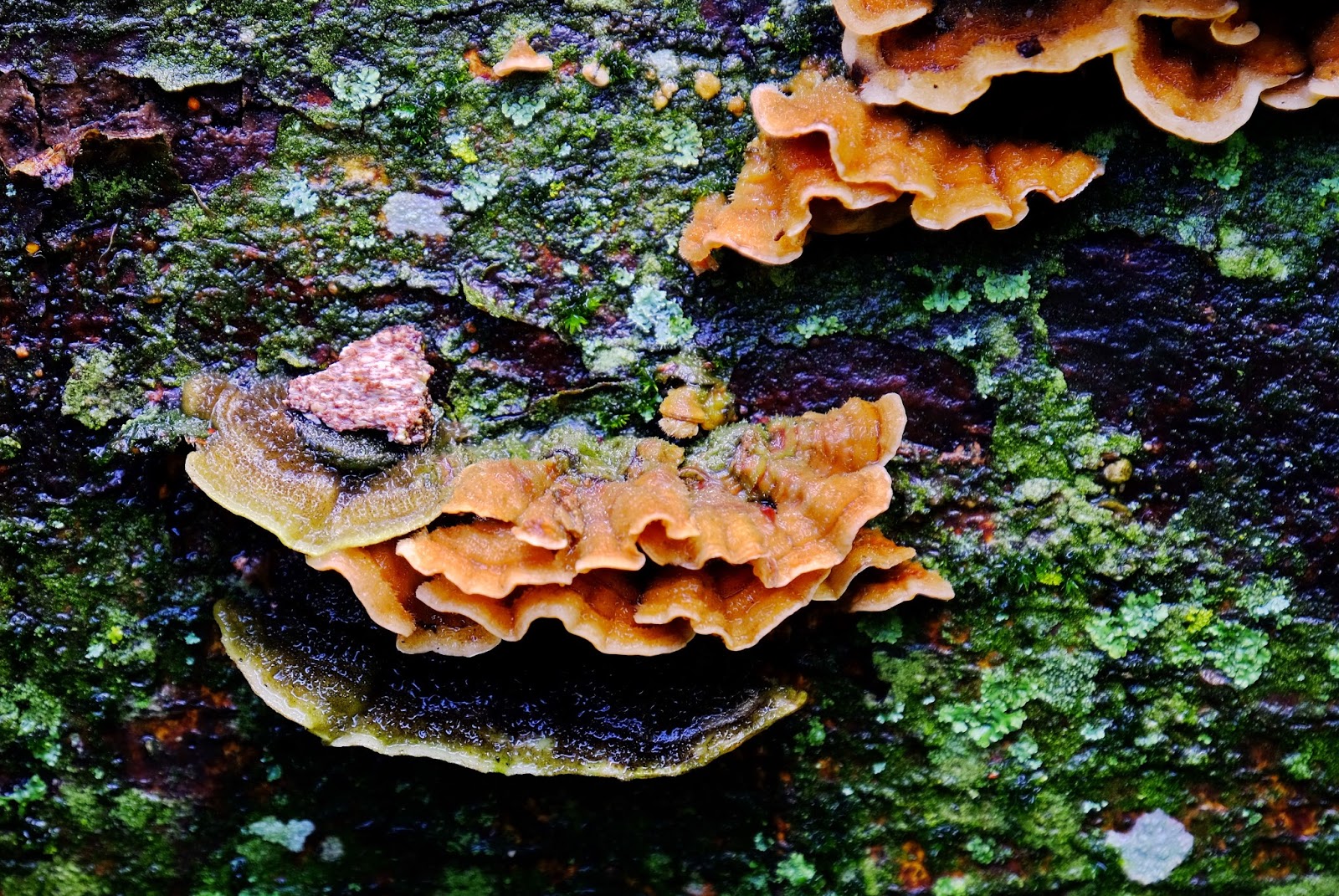
Lichen and fungus are growing on tree trunks

showing us their own kind of beauty

Raindrops glisten

A recent walk down by the lake shows the late blooming flowers

A tiny aster blooms on my balcony

The last dahlia buds have opened in the last few days of brilliant sunshine

and an autumn rose blooms in a neighbouring garden.

But the plums are ripe and perfect for making tarts,
like this traditional one I made yesterday, for the Jeûne Fédéral holiday,
which is always on the third Monday of September
in the canton of Vaud where I live.

The collage shows the different stages of the tart making.
The plums are dark purple in colour. They need a little sweetening
with Sucanat, a natural brown cane sugar.
I make my own shortcrust pastry from a recipe by Julia Child.


I hope that you are also taking pleasure in the joys of the season!


Thursday, September 14, 2017

Big Bald Mountain

Let's Climb Big Bald Mountain
View From Near Top of Big Bald Mountain
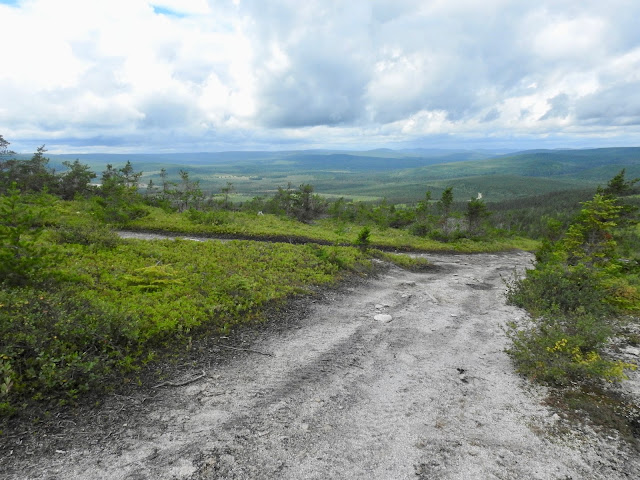
On August 20 a small group of botanists climbed Big Bald Mountain in Northumberland County.  The road leading up the mountain is about a half hour north of Red Bank, near Miramichi City.  We were able to drive to the foot of the mountain, leaving an hour climb up a steep trail.  It was interesting to watch the vegetation change as we climbed.  Northern/alpine species of plants grow only on mountain tops in New Brunswick.  

View From Top of Big Bald Mountain
We saw lots of moose sign on our way up.  It was surprising to me to see that moose could find something attractive to eat way up there.  We also saw flocks of White-winged Crossbills and Dark-eyed Juncos and heard Fox Sparrows.  As we climbed, the vegetation got shorter and sparser.  The view was spectacular from the top.  You could see for miles, mostly untouched wilderness.  We could, however, see vast areas of former and some new clearcuts.  There were a few roads and two or three lakes.  One lake had a cabin on its shore.  The air was so pure and there were no sounds other than those of nature.  Such a delight to be there!

The most outstanding plant we found was the Highland Rush Juncus trifidus.  This is an extremely rare plant found only once before in the province in the same area in 1982 by H. Hinds.  It is normally found on peaty heathland in Hudson Bay, Baffin Island, northern Newfoundland, Greenland, Iceland and Eurasia.  That was a very important find!


Juncus trifidus
Juncus trifidus
The dwarf birches were interesting.  It is hard to believe they can become so small and low-growing.  It is amazing how nature can adapt to harsh growing conditions.  We saw Betula glandulosa and Betula minor.  The Betula glandulosa was so low to the ground we had to get on our knees to photograph it.  It is a true dwarf and apparently reaches only 2 metres when fully mature.  What we saw was up to 30 cm tall.  Its leaves are very tiny and one would wonder if it really is a birch.  It is also extremely rare (S1).  

Betula glandulosa Dwarf Birch
An interesting fern was growing on the cliff face at the top of the mountain, Dryopteris fragrans, Fragrant Wood Fern.  Although this species is not unduly rare (S3), it was spectacular in the site in which we found it.  It required mountain goat-like agility to get close to it.  Plants are amazing how they can populate the most severe areas.  Fragrant Wood Fern normally is found from Yukon to Newfoundland and south to New England.

Dryopteris fragrans Fragrant Wood Fern

Dryopteris fragrans Fragrant Wood Fern
Canadian Mountain-Rice was another interesting find (Piptatherum canadense).  It is also an S1 plant, meaning extremely rare.  It grows on sandy barrens and rocky outcrops from British Columbia to Newfoundland and south to New Hampshire.  

Piptatherum canadense Canadian Mountain-Rice
Are we getting a pattern here?  Amazing how many rare plants are growing up there.  Another S1 plant we found was Vaccinium boreale Alpine Blueberry.  It was growing in small patches among
 the more common blueberry, Vaccinium angustifolium.  Alpine Blueberry is remarkable in how small it is.  It was only about 5 cm high!  Its berries were small and sweet.  This plant was first found in the province by H. Hinds at this location in 1982.  

Vaccinium boreale Alpine Blueberry
We also found Mountain Cranberry, Vaccinium vitis-idaea.  This is not particularly rare but is not something I see very often.  It is the common Partridgeberry of Newfoundland.  

Vaccinium vitis-idaea Mountain Cranberry
Another interesting find was Northern Comandra Geocaulon lividum.  This is a parasitic species and is listed as uncommon (S3).  It grows in sphagnum bogs and dry sandy areas from Alaska to Newfoundland south to New England.

Geocaulon lividum Northern Comandra
This was a very rewarding and unique botany trip.  To find so many extremely rare species was exciting.  We were viewing parts of New Brunswick few people have seen.  Although many have climbed Big Bald Mountain, I am sure most did not realize what an important ecological area it is to support such rare plants.  We are so blessed to have such areas still relatively untouched in New Brunswick.  It is our responsibility to protect them.

Sunday, September 10, 2017

When Summer Lingers

This is the time of the year
when late summer and early autumn join together
as the autumn equinox approaches.

I notice this as the hydrangea leaves change colour with splashes of red.

The petals take on a more muted shade

and shades of green come back rather like in the springtime

The dahlias are having their last fling in glorious full bloom

and showing the intensity of their varied colours

Bees are still busy taking advantage of the sunny days to collect pollen.

and the Golden Rod lights up the gardens

and Rudbeckia blooms dazzle us with their sunshine petals

until one day it starts to rain
and the first autumn leaf floats down to remind us
a change in seasons is taking place.

***

The last blog header to remind me of earlier days
when sunflowers still waved in the fields.


Thursday, September 7, 2017

Eastern Phoebe Second Nesting

The Phoebes Have Fledged

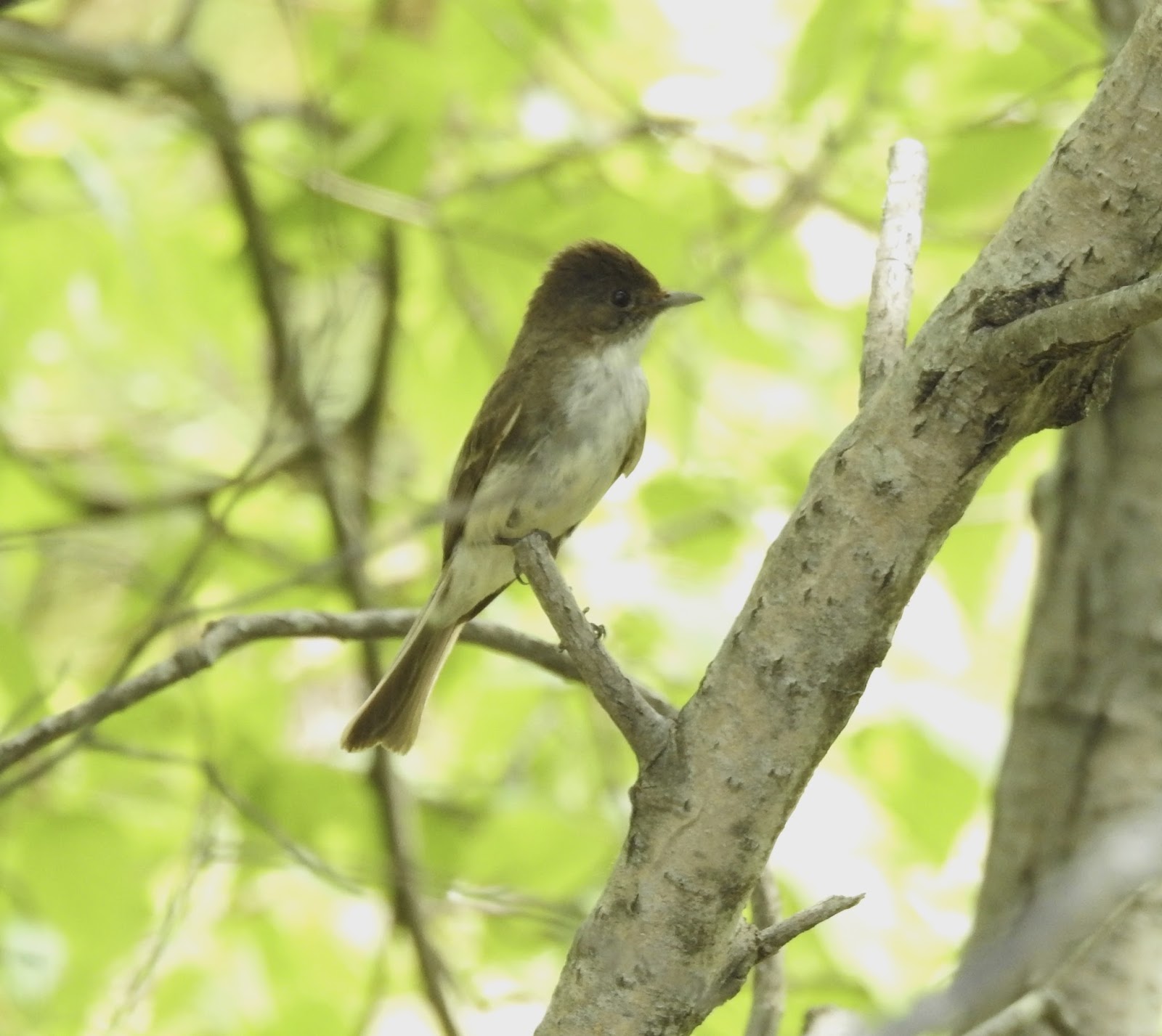
Eastern Phoebe
This year we had a pair of Eastern Phoebes (Sayornis phoebe) nest under our raised deck.  They raised two clutches and were more successful in the second clutch.  The first clutch was parasitized by Brown-headed Cowbirds.  See a previous post for more details (June 17, 2017).  The first clutch had 3 phoebe chicks and 1 cowbird chick.  The second clutch had 3  or 4 phoebe chicks.  

Eastern Phoebe Fledgling
The phoebes like to nest on or near human habitation.  In our case they built on top of a shelf over a light affixed to the underside of a raised deck, a secure, dry spot indeed!  The nest was made of mud pellets and moss and lined with fine grasses.  Such fine workmanship!

After the eggs hatched, both parent phoebes were very busy feeding the hungry chicks.  Every possible perch around our yard was used by the adults as they hawked insects.  The youngsters grew quickly and were poking their heads up at the least sound or motion near their nest.  

Eastern Phoebe Fledgling
The chicks fledged at age 2 to 3 weeks.  I was made aware of the eventful day by our dog who was witnessing the event from inside the house.  I didn't know what the commotion was about until I went out to hang clothes on the line.  A baby phoebe landed on the line right beside my hand!  I was able to gently stroke its breast while it decided what its next move would be.  That was a neat experience.  With the dog securely shut inside, I waited outside to watch the event.  There were 3 or perhaps 4 very young phoebes wheeling around unsteadily, obviously trying their wings and this new mode of transportation for the first time.  The adults were noisily giving advice from the sidelines.  It did not take long for the young ones to gain more control of flight and to get themselves hidden away in the shrubbery.

Eastern Phoebe Fledgling
I felt privileged to have been a witness to the rearing of at least 6 new phoebes this year.  Our yard was a good nesting site and we are grateful for all the insects that have been removed from our environment.  We are especially pleased that this second clutch was not parasitized.

Eastern Phoebes make great neighbours.  They unobtrusively build their nests and raise their young around our buildings and help rid our areas of insect pests.  It is nice to watch them perch on garden stakes, lamp posts and every other suitable perch while watching for the next meal to come within  range.  We will certainly miss our phoebes when they leave for their wintering grounds in southeastern US and Central America.  Safe journey, friends!

Tuesday, September 5, 2017

Kiefer and Jack Challenge


Dear Friend,

You know, you never can tell when you’ll make a connection with a very special animal (or two!). Somehow, they just seem to work their way into your heart more than the others. And for me, Kiefer and Jack were two of those very special pets.

I’ll never forget the first time I saw them. Once I locked eyes with them from behind their kennel door, it was love at first sight. I decided to foster them … even though I knew it would not be a temporary situation.

So, I brought them home but soon after, I realized there was something not quite right. They were starting to exhibit signs of upper respiratory infection … which quickly became much more severe.


Coming from a hoarding situation, Kiefer and Jack were two of 17 cats who lived in a filthy and disease-infested house. They never received veterinary care ... not even basic vaccinations. It was no wonder that their infections were soon out of control.

I knew I needed to get them back to Animal Friends – and fast. There they would receive the emergency medical treatment they so desperately needed.

It was heart wrenching not being able to see or help them, but I knew they were in the best place possible. They were at Animal Friends.

Over the next few weeks they were nursed back to health. Soon enough, they were ready to come home with me – permanently.

But there are so many more animals, just like Kiefer and Jack, who are struggling and still need your help.

I’m so committed to saving the lives of these desperate pets that right now I will match every gift 50 cents on the dollar, up to $100,000, through Sept. 16. And, I’d like nothing more than to donate the entire $100,000 – knowing my challenge was maximized!

So, please click here to make a gift … because, together, we can save more lives.

Warmest regards,

Stefania Romoff
Vice Chair
Animal Friends Board of Directors
(... and Kiefer and Jack's mom!)

Sunday, September 3, 2017

Bertha: Scene and Story - August 2017

Bertha and the heat-wave.

Bertha mopped her brow as she staggered out of the relentless heat of the midday sun.
She had spied a comfortable looking chair in front of a boutique
and plopped herself down on it.
"Whew!" she said to herself, slightly out loud,
"I can't take much more of this heat."
Her feet were killing her
 and she knew that she shouldn't have worn her red shoes with the pointed toes.
She glanced down at her nail polish,
even that seemed to be melting ... or was it a trick of the light?

After a few minutes, the shopkeeper came out and said:
"Would you like a fan too?"
Bertha wasn't sure if the woman was being facetious,
so she said: "Oh yes please, if you're selling them!"
They did, and Bertha bought one!

The shopkeeper said: 
"I can't believe this! The back of my chair is covered in the same material as your dress!
I made it out of a remnant from last year's stock."
"So it is", said Bertha, 
"I bought the material here last year and made the summer dress I'm wearing."
The shopkeeper smiled, looking pleased and warming to Bertha.
"Why don't I go and get us both a glass of iced water," she said.
Bertha smiled back and felt grateful
and thought how nice it was that the heat-wave had made her seek out a shady spot.
Now she had a new fan, a glass of cooled water and a friendly shopkeeper with whom to chat.

Life is good, she thought to herself, even during a heat-wave 
... especially in the shade!

*****


Friday, September 1, 2017

Buff-breasted Sandpiper

Rare Sandpiper Visits Miscou

Buff-breasted Sandpiper
On Tuesday, August 29, we made a long, rather difficult trek north of Wilson's Point on Miscou Island to look for shorebirds.  We have been visiting this place every late summer for a number of years now.  It is a good birding spot.  Mal Baie Sud has a large pond which is flushed daily by tides.  It is surrounded by marsh and is separated from the open ocean by a large sand dune.  The ocean has broken through the dune, hence the daily flooding of the bay.  There had been a report of a Buff-breasted Sandpiper from the area so we were looking especially for it.

The area is difficult to check because of the mile-walk in to the area along the beach followed by a bit shorter walk along the bay.  When you get back to your car, you have walked about 3 to 4 miles.  To make it even more difficult, the reported bird was seen across the cut made in the sand dune by the ocean, requiring you to cross a deep stream flowing out of the pond.

Buff-breasted Sandpiper
There were lots of shorebirds in the area.  We saw many Semipalmated Sandpipers, Semipalmated Plovers, Black-bellied Plovers,  Greater and Lesser Yellowlegs, Short-billed Dowitchers, White-rumped Sandpipers, a Baird's Sandpiper, Least Sandpiper, and Ruddy Turnstones.  As we reached the uppermost section of the sand dune I spotted the special bird.  There it was feeding heavily on some black-coloured invertebrates.  The bird was moving quickly along a row of vegetation very intent on feeding.  With camera on tripod I was clicking digital images quickly, knowing the window of opportunity was probably short.  We did not approach closely and let the bird continue its feeding.  Fortunately I had a superzoom camera.

Buff-breasted Sandpiper
First impression was a rather large sandpiper (21 cm/ 8.3 in) and its buff colour was not as dark as other Buff-breasteds I have seen.  The large dark eye stands out in contrast to the buffy head.   It has long yellow legs so appears to stand tall.  It does stand straight up at times.  Its beak is long and the pattern on its back is prominent.  It is a very beautiful sandpiper!  Its shape makes you think it is related to the Upland Sandpiper.

The Buff-breasted Sandpiper is a rare fall migrant to this area.  It nests in the Canadian Arctic and most birds fly south on the central flyway down the central part of North America to southern South America where it winters in Uruguay, Paraguay and Argentina.  What a huge distance to fly!  A few bend their route to come over the Maritimes where they have been seen in the Acadian Peninsula and on Grand Manan.  This species needs abundant feeding areas here to refuel for its long journey to South America.  It prefers to feed on the drier parts of the marshy shores.  This is exactly where we found it, feeding about 20 metres from the wet mud and water.

Buff-breasted Sandpiper
This is the only species of North American shorebird that uses the lek system to attract mates.  Males join together and perform bold wing displays in order to attract females.  This species was very abundant in the 1800s and early 1900s.  By the 1920s market hunting had decimated their population, nearly driving them to extinction.  The species numbers are still trying to recover!  It is our responsibility to see that they have safe, clean, abundant feeding areas while passing through our region.