Sunday, June 17, 2012

Chinese Fire Belly Newt

  
The Life of Animals | Chinese Fire Belly Newt | In AD 1008 years, a Chinese author mentioned that a small black salamander was found in aquatic weeds in pools on the prairie Mou. For animals that survive the transportation, mortality rates are very high given the poor cattle in pet stores or the ultimate owner. If the animals in captivity can not be found, make sure to buy an animal in good condition. Open wounds, missing limbs, fungi and animals too thin to be passed over, or even seemingly healthy individuals if the newts deaths are in the tank. While many people buy sick animals, out of pity or with intent to breastfeed return to health, the purchase of these animals simply encourages poor care on behalf of the owner of the pet. Orientalis Cynops better in a tank not heated to temperatures between 58-68 ° F (14-20 ° C). Temperatures above 74 ° F typically result in high levels of stress or death. The failure of newts to enter the water can be a sign of stress, poor water quality, or other health problems. Typically, five gallons of aquarium animals is ideal, but the smaller tanks may have water quality problems.


Including live plants in the aquarium can help maintain healthy water quality, providing coverage for pregnant newts and more attractive. Animals mixture of other amphibian or fish or other, with C. orientalis is discouraged Other animals can be aggressive, disease-carrying foreign, have different requirements for housing, and may eat or be eaten by the newts. Firebelly toads (Bombina orientalis), newts Paddletail (Pachytriton spp.), Crabs and various fish are often poorly maintained together in pet shops. Moreover, several toxins newts can be fatal to other species. Few species of fish from cold water fish like small white clouds are generally considered acceptable as cohabitants of C. orientalis, but they can still carry diseases, parasites or be eaten by newts hungry.


Newts in captivity can eat chips or dried foods, although some animals may refuse it. Foods that are easily taken may include bloodworms are the larvae of chironomids, worms, water fleas, such as Daphnia, Artemia adults Blackworms or mosquito larvae. Newts can also eat tadpoles and small fish, but these foods have a higher risk of transmitting diseases and parasites, are wild caught. Aquatic plants and layers of plastic strips (thin strips of clear plastic garbage bag tied to a rock or other heavy object) works fine, and plastic strips may be preferable to living plants. The eggs are deposited or placed in plastic plants, with some eggs laid each day.

Chaco Horned Frog


The Life of Animals | Chaco Horned Frog | Cranwell of horned frog (Ceratophrys cranwelli), also known as the Chaco horned frog, a frog is endemic to dry land of the Gran Chaco in Argentina. Like most members of Ceratophrys generally, are often considered Pacman frogs because of their resemblance to the popular video game character of the same name. The backs of these frogs are usually dark green and brown coloration, although albino variants with orange and yellow back even exist. The model allows to camouflage dark color as the animal burrows and waits for its prey.  In the case of extreme temperatures, Cranwell frogs enter a period of aestivation, the development of a thick protective layer of the skin to retain moisture and aid in breathing. When estivation is complete, the frog uses its front legs and rear to help remove the protective layer. In many cases, the frog uses the jaws to pull the skin on the back, often eat the skin in the process.


How Pacman frogs, Cranwell are popular as pets. The foreign body can be anything, but Pacman frogs kept as pets, usually a small stone or piece of gravel used as substrate. In severe cases, the volume of stool in the intestine is so great that the lungs are clogged and respiration of the frog is compromised.

Saturday, June 16, 2012

Cane Toad


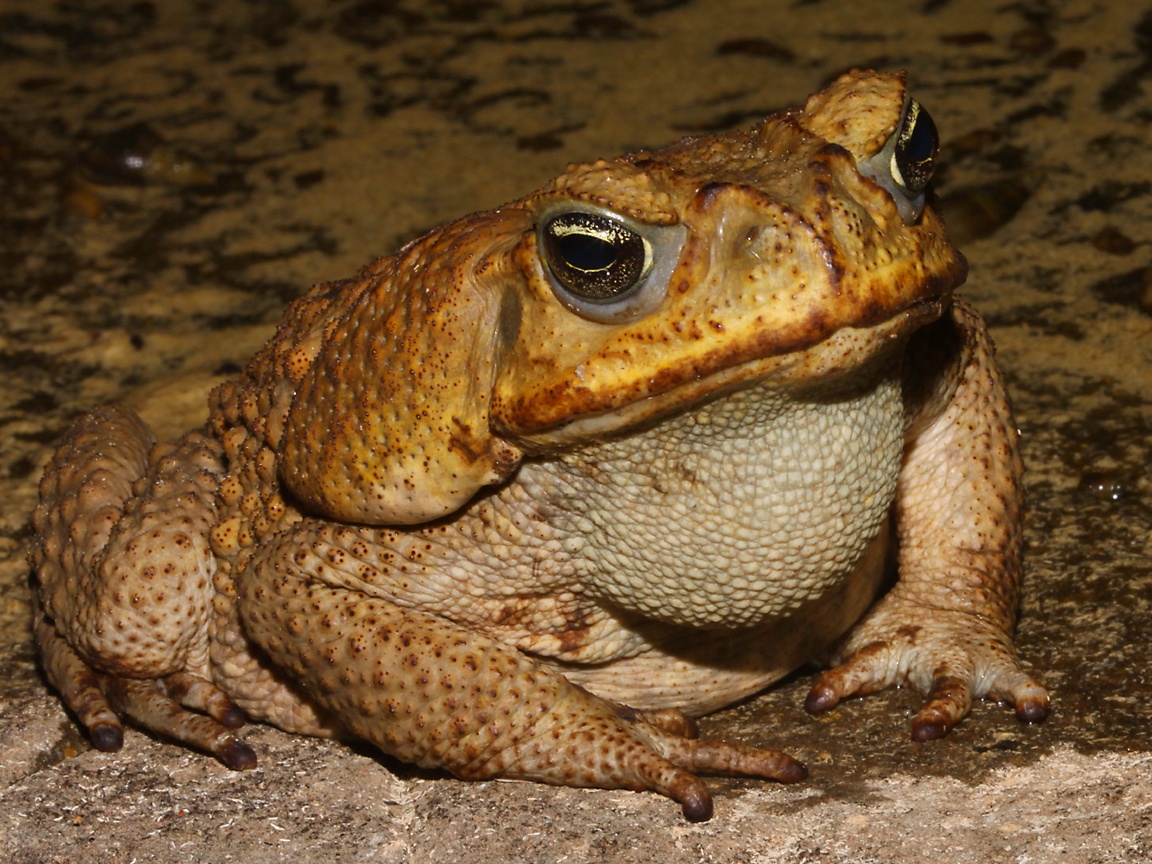
The Life of Animals | Cane Toad | A huge cane toad women more than men reach an average length of 10-15 cm (3.9 to 5.9 in). Held "Prinsen", a toad as a pet in Sweden are listed in the Guinness Book of Records as the largest recorded pattern. Individual cane toads can be gray, yellowish, reddish brown or olive brown, with various patterns. Juvenile toads cane is much smaller than adult cane toads 5-10 cm (2.0 to 3.9 inches) long. Tadpoles in the range of 10 to 25 mm (0.39 to 0.98 inches) long. The title "Marine Toad" and the scientific name Bufo marinus suggest an association with marine life, and adult toads cane entirely terrestrial, just dare to breed in fresh water. While the growth rate varies by region, season and sex, and train train find average initial growth rate of 0.647 mm (0.0255 inch) per day, and then averaged 0.373 mm (0.0147 inch) per day. The growth is slowing is usually only toads sexual maturity, the rapid growth of their survival during metamorphosis and sub-adult, losing young toads to their toxicity, which protects them, such as eggs and tadpoles, but not yet fully developed parotoid glands much produce bufotoxin the Because they do not have this key, it is assumed that only 0.5% of the cane toads in adulthood


As in the growth rate varies, the point at which the frogs become sexually mature in different regions. In New Guinea, the sexual maturity of the female toads snoutvent length of 70 to 80 mm (2.8 and 3.1), while the toads reach maturity in Panama, when they are between 90 and 100 mm (3.5 and 3.9 inches in) long. Cane toad has a high resistance to water loss, a study showed that some of them can resist the 52.6% loss of body fluid that they can survive outside the tropical conditions. Adult skin is poisonous cane toads, as well as an enlarged parotoid glands behind the eyes and other glands on their backs. When the toads are endangered, glands, milky-white liquid bufotoxin known. Bufotoxin components are toxic to many animals, there were even human sacrifice in connection with the consumption of cane toads. Bufotenine, a chemical substance secreted by cane toad is classified as a Class 1 drug under Australian law, along with heroin and cannabis. It is assumed that the effect of including similar to a light bufotenine poisoning stimulation, mild hallucinations, takes less than an hour as a cane toad bufotenine allocated in small amounts, and other toxins in relatively large quantities, could lick toad in serious illness or death is run.


In addition to the production of a toxin capable of cane toad inflating its lungs, puffing, lifting his body off the ground it more and more of a potential predator Toxic toads sausages with meat are currently trying in the Kimberley (Western Australia) to, to protect domestic animals from the lethal effects of cane toads tested. Mixing bits of toad cause nausea chemical, bait animals trained to stay away from amphibians. Many species prey on cane toad in their homeland. Predators outside the natural range of the cane toad include Whistling Kite (Haliastur sphenurus) Rakali (Hydromys chrysogaster), black rat (Rattus Rattus) and the Water Resources Act (Varanus Salvator).


There have been occasional reports of Tony Frogmouth (Podargus strigoides) and Papuan Frogmouth (Podargus papuensis) eating cane toads. It is likely that the opossum Didelphis genus of cane toads can eat with impunity. Besides the already mentioned use as biological control of pests, cane toad has used in several commercial and noncommercial applications. Traditionally, the natural habitat of the toads in South America, "milking" the toad, the Embera-Wounaan their toxins which are then used as arrow poison.


The toad has parotoid glands as a source of food hunting in some parts of Peru and eaten after removing the skin. Pregnancy tests were in the middle of the 20th Century by the introduction of the urine performed by women in the male toad lymph sacs, and if the sperm appeared in the urine of the toad, the patient is pregnant. Is considered ideal in experimental animals cane toad, they are plentiful and easy to maintain and operate and inexpensive. Even a dead toad matter. Cane toad skin was stuffed into the skin and novelty items cane toads, supplied and installed, has found a home in the tourist market, as well as attempts to produce fertilizer from their bodies.

African frog


The Life of Animals | African frog | African frogs are carnivorous and voracious eaters, feeding on insects, small rodents, reptiles, small birds and frogs, amphibians, and positive, and is known to bite when provotsirovali.Afrikanskie frogs kept at Pretoria Zoo in South Africa once ate 17 baby cobras (Hemachatus haemachatus). The African frog (Pyxicephalus adspersus) is a species of frog in the family Ranidae. The natural habitat is dry savanna, moist savanna, subtropical or tropical dry shrub, freshwater lake constantly, constantly fresh marshes, arable land, pastures, and channels.


Argentine Horned Frog

  
The Life of Animals | Argentine Horned Frog | Females can be up to 16.5 cm (6.5 inches) from snout to vent (SV) and men was 11.5 cm (4.5 inches) VS. Color is usually light green with red spots, but dark blue, parti-color versions of black and albino exist. Frog hunting horns remaining motionless, waiting for prey. In nature, the typical diet will include rodents such as mice, small reptiles and large spiders and insects such as grasshoppers. Horned frog is known for its reputation for courage. They try to eat animals, sometimes even their size. When kept as a pet, usually horned frogs feed primarily on large adult grasshoppers, crickets and black and brown rats, but also enjoy depending on fish size.


Sexual reproduction. Argentine Horned Frog Females lay about 2,000 eggs in water and in two weeks to become tadpoles. Known in the pet industry as Pacman frogs, in Argentina diversity of species is usually resistant and easy care. Argentine Horned Frog has some simple requests such as a pet. A We recommend keeping the horned frogs only way to avoid cannibalism. A heating pad can be used to adjust the temperature, however, the pad should be placed on a water surface and below so as not to prevent overheating frogs buried.


Daily misting with distilled water (hard water stain removal on glass) can help achieve optimal levels of humidity. Do not spray directly to your frogs in distilled water or distilled water to soak offer. Water treated with chlorine, or better, spring water must be used for dipping purposes. Juveniles can be fed appropriate vitamin / calcium dusted 3-4 size every two days. Adults can be fed adult crickets, cockroaches, earthworms or three times a week. Frogs have difficulty digesting the tissues in mammals and high fat content of mice can lead to fatty liver disease.

Wednesday, June 13, 2012

Kakapo


The Life of Animals | Kakapo | Kakapo parrots large round male measures up to 60 cm (24 inches) and weighs from 2 to 4 kg (4-9 lb) at maturity. Kakapo can not fly, having short wings for their size and lack of pronounced keel bone (sternum) that anchors the flight muscles of other birds. Unlike other species of land birds, Kakapo can accumulate a large amount of body fat for energy storage, making it the heaviest parrot. At the top of the Kakapo have yellowish green moss, or mottled feathers are prohibited, black or dark gray-brown, stirring well with native vegetation. Belly, tail, neck and face mostly yellow, streaked with pale green, slightly mottled brown-gray. Kakapo has a few feathers notable person driving fine, owl like face, so that the first European settlers called the "owl parrot". Beak surrounded by thin mustaches, or "whiskers" that birds use to test the waters to navigate, as he walks with his head down. Kakapo feet are large, scaly, and, like all parrots, zygodactyl (two toes pointing forward and two steps back). End of the tail feathers are often worn by the constant slip on the ground.


A woman can be easily distinguished from that of men: he is the head narrower and less domed, its beak is narrow and proportionately more of its ceremonies and nostrils small feet and legs are thinner and pinkish gray, and its tail is proportionately larger. It seeks to confront more and more aggressive than men when treated. Like many parrots, Kakapo has a number of challenges. Kakapo is a well-developed sense of smell, which complements its nightlife. The smell is often warns predators Kakapo largely defenseless. It seems that the Kakapo and many species of birds of New Zealand has evolved to occupy an ecological niche, usually filled with various mammalian species (marine mammals not native to New Zealand, three species of bats small). Before the arrival of humans, Kakapo were distributed in all three main islands of New Zealand. Although the Kakapo can not fly, it is an excellent climber, climbing to the tops of tall trees. A woman, he made two trips back each night during the nesting season of its nest to a food source up to 1 km (0.6 miles), and men can walk the house scene of a range of coupling to 5 km (3 miles) during the breeding season (October-January).


Young birds have a fighting game and enter the neck of a bird is often the other under his chin. Kakapo is curious by nature and are known to interact with people. Conservation staff and volunteers engaged widely with some Kakapo, which have different personalities. Kakapo was a very successful species in pre-human New Zealand and one of the reasons for this have been a lot of accessories to effectively avoid predators of local birds of prey, which are their only predators in the past. All four species rose to head the search for prey in the day and avoid the birds of prey, whose ancestors camouflage uniform and Kakapo became night. Predatory mammals, unlike birds, rely on their sense of smell and hearing to find prey and often hunt at night. The usual way for people to track down the Kakapo is the liberation of trained dogs Kakapo is the only type of parrot fly around the world, and only flightless bird that has a lek breeding system. Men are free to assemble in the arena and compete with each other to attract females. Women listen to men, because they show, or "leks They choose a mate based on the quality of its display, if not pursued by men in any way to open a pair bond is formed. Males and females meet only to mate.


Men remain in their camp during the mating season. Fight against birds may leave injury or even kill them. Kakapo is a rare bird in the world that built its current bowls are often created alongside the rocks, banks or tree trunks, to reflect the sound of the bowl itself act as amplifiers for increase the projection of the growth in male mating calls. Each bowl man linked network of trails and paths, which can range from 50 meters (160 feet) along the ridge or 20 meters (60 feet) in diameter around the hill. Men clean their bowls, and traces of debris. To attract females, males emit a strong low frequency (below 100 Hz) calls booming Cup, enlargement of the bag. After a sequence of about 20 loud explosion, a man Kakapo radiates high frequencies, metallic "ching" sound. Men are growing at an average eight hours a day, every man can produce thousands of arrows at that time. Once a woman enters the yard of one of the men, male performs display, in which he sways from side to side and makes a clicking noise with his beak. Once the birds are mated, the woman returned to his home region to lay their eggs and raise chicks. The man continues to thrive in the hope of attracting another woman. Female Kakapo lay up to three eggs per breeding cycle.


The female incubates the eggs is true, but to leave every night in search of food. Kakapo eggs usually hatch within 30 days, with fluffy gray chicks that are totally helpless. Young chicks are vulnerable to predators, like an egg, and the young were killed, many of these predators that attack adults. The men begin to grow rapidly until about 5 years. Usually, women do not seek men, until they are between 9 and 11 years. Kakapo do not breed every year, and has one of the lowest rates of reproduction in birds. Mating occurs only in years when trees mast (fruit heavily), providing an abundance of food. Rimu mast occurs only once every three to five years, and the dominant Rimu wood, such as cod in the island, Kakapo breeding occurs rarely. Another interesting aspect of breeding Kakapo is that a woman can change the sex ratio of offspring depending on its condition. A woman who eats protein-rich foods produce offspring more men (males have a weight of 3% -40% more than women). Women produce dispersion-shifted offspring sex when competition for resources (eg, food) is high and non-dispersive sex when food is abundant. Female Kakapo, will probably be able to produce eggs, even though there are a few resources, while men are more capable of Kakapo to perpetuate the species, when there are lots of things, by mating with several females . Kakapo is associated with the rich folklore traditions and beliefs of Maori. Irregular cycle of breeding birds to understand because of the heavy fruiting or "rigging" the events of different types of plants such as Rimu Maori, which led to credit the bird with the ability to predict the future.

Saturday, June 9, 2012

Japanese Squid


The Life of Animals | Japanese Squid | Adult squid have several distinctive features. Mantle covers the visceral mass of the squid, and has two edges, which are not the primary method of movement. Instead, the squid is a siphon muscle, which takes in water with one hand, and it pushes the other side jet propulsion. Squid have eight arms and two tentacles with suction cups along the back. Squids have ink sacks, which they use as a defense mechanism against potential predators. Squid and three hearts. This species of squid can weigh up to 0.5 kg. Mantle length in females can reach 50 cm, smaller males.


Japanese squid can live anywhere from 5 ° to 27 ° C, and generally inhabit the upper layers of the ocean. About 25 different species of squid swimming in the language of Vietnam only. During the years of life, squid larvae mature out of shape, eat and grow, and migration at the end of his life, going to the breeding grounds, where they multiply. Three subgroups were identified in Japanese waters. Squid usually live only one year, because when they reproduce, they die. Then the path continues south, women are "mature and lay eggs from 300 to 4000 small eggs elliptical, or hemispherical." Many vertebrate predators depend heavily on squid, which is second only to krill as a food source in the Southern Ocean. Animals such as albatross and gray whales (the largest of the toothed whales) feed almost exclusively on squid predators of other dolphins, seals, baleen whales and rays.


Temperature (C) the relative growth rate (% per day) intake (body weight / day) food Fish 16 0.06% 30 A study Sakuri. Squid can grow and reproduce better in the laboratory.