Thursday, January 9, 2020

Black-backed Woodpecker

Black-backed Woodpecker - A Three-toed Woodpecker

Black-backed Woodpecker [Yvette Thibodeau Charette Photo]
The Black-backed Woodpecker (Picoides arcticus) is a native of New Brunswick.  It is an uncommon resident which breeds sparingly across the province mostly in the central and northern parts of the province.  It prefers coniferous forest, especially forests with plenty of dead or dying trees.  The photo above was taken on 5 January 2020 at Edmundston.  The woodpecker is feeding on insects found under the bark of a conifer, probably a spruce or a fir.  

The Black-backed Woodpecker is a medium-sized woodpecker, about 24 cm/9 in long.  It is about the same size as our Hairy Woodpecker.  It is an uncommon woodpecker and seeing one makes a good day for a birder.  I have seen this species many times over the years and it is almost always in an area of dead trees, often an area where there are lots of tamaracks.  I hear a faint tapping among the trees and on listening carefully, I attempt to locate the source of the tapping.  Sometimes it will be a Black-backed.  It is a shy bird and not easily seen.  It will often continue feeding, usually placing the tree trunk between itself and the viewer.  It usually does not vocalize.  

Black-backed Woodpecker [Dorothy Chase Photo]
The photo above was taken on 6 January 2020 in the Ayers Lake area.  The individuals in each of the photos above are females.  The males have a conspicuous yellow patch on the forecrown.

The Black-backed Woodpecker has black upper parts.  Its head is black with a white malar patch which extends behind the eye.  It has barred flanks, a black tail with white outer tail feathers. The only other species one would need to distinguish this species from is the American Three-toed Woodpecker (see previous post on this blog).  The American Three-toed Woodpecker has a black-and-white barred back and a white line behind the eye.  

The Black-backed Woodpecker and the American Three-toed Woodpecker are the only three-toed woodpeckers in North America.  They have two forward-facing toes but just a single backward-facing toe.  Other woodpeckers have two toes in the back.  Both the Black-backed and the American Three-toed Woodpeckers share similar habitats.  They feed by flipping off large chunks of bark from dead and dying trees and feed on the insects and larvae underneath.  This leaves telltale evidence of their presence.  They are often found feeding in burnt-over forested areas or in areas devastated by insect damage.  The range of both species is similar; most of southern Canada including all of the Atlantic Canada and Quebec north to southern Labrador.  

The Black-backed Woodpecker's call is a sharp pik.  This species nests in holes in coniferous trees where it lays 2 to 6 white eggs which are incubated for 12 to 14 days.  The nest hole is often close to the ground but can be up to 4 m/15 ft high.  The young leave the nest after about 25 days. 

The diet of this species is mainly wood-boring beetles, grubs, weevils, ants and spiders.  They will also feed on berries, small fruits, acorns and nuts.  An interesting fact is that females have been shown to forage higher in the trees than males.  It is interesting to speculate why.  

The next time you are wandering around in the woods and you see softwood tree trunks with large patches of bark removed, there may be Black-backed Woodpeckers present.  Listen for their tap-tap and you just might be lucky enough to see one of our uncommon woodpeckers!

Wednesday, January 8, 2020

The Colours of January

The illuminated Lausanne Cathedral
as the bells rang out to celebrate the New Year!
The crowds were dense, but we found a bench to sip our mulled wine
which I had made at home and put into thermos mugs!

The tower was bathed in a deep blue light afterwards
and the crowds dispersed to continue their celebration
or to go home
I'm not a night owl, so I did the latter!

A delicate sunrise taken from my balcony with the cock on the church steeple.

I enjoy my daily walks and loved these tiny oval red berries
hanging on the branches like Christmas lights.

The centre of a beautiful Amaryllis bloom which opened up on Christmas morning.

A late afternoon walk with sun-kissed branches and a waxing moon
rising higher in the sky.

I decided to crochet a Temperature Blanket for the very first time.
These are the colours that represent the temperatures in the first seven days of January.
Cool colours, which are my favourites.
The average daytime temperature has been around 6-7 Celsius.
The dominating colours so far are Wisteria and Sherbet.

The middle round of the small squares is the coolest temperature of the day 
and the second round is the warmest.
I'm using white to join all the squares.

I couldn't resist getting a small pot of sunshine in the shape of these yellow Primula.

My daughter and I went to see the new film version of the musical 'Cats'.
It was very good. The costumes and settings were wonderful!
We had already seen it in London some years ago on the stage.

The Magnolia buds look very promising against the Winter's sky.

A small perfect rosebud was still blooming in one of the neighbourhood gardens.

Tightly encased catkins still know that they have to wait a little longer
before stretching their limbs!
I have used this image for my January header.
It's a subtle reminder that Spring follows Winter.

More catkins in the park nearby against a gorgeous limpid blue sky.

Another beautiful sunrise in shades of pink, blue, lilac and purple.

This one inspired me to take out my coloured yarns to start a separate crochet project

Here are all the colours.
Seven squares already joined in a row.
I'm considering adding single coloured squares to frame the others.
I've chosen Bluebell to do this.

This month of January is full of new energy
and we're already gaining an extra minute every day.

We are getting some grey days but a generous amount of sunshine and clear blue skies as well.
January doesn't need to be dull
it can be whatever we want it to be!
We just need to seek out the colour and beauty around us
and if we can't see any ...
well, let's just create it!

Sunday, January 5, 2020

Nature: Witch hazel blooms add burst of color to winter

Witch hazel in full bloom/Jim McCormac

January 5, 2020

Witch hazel blooms add burst of color to winter

NATURE
Jim McCormac

Fall’s native flora disappeared months ago. The last of autumn’s flowers gave up the ghost by early November or so. Colorful asters, beautiful gentians, the last of the sunflowers — spent and returned to the soil, ushering in winter’s long, brown season of wither.

For people of a botanical bent, winter is a tough time of floristic withdrawal. Those who ride out our coldest season at northerly latitudes face many months of botanical barrenness. It will be late February before the emergence of skunk-cabbage heralds the onset of spring wildflowers.

Fortunately, a hardy fall-and-winter-blooming shrub snaps the long flowerless streak. Witch hazel (Hamamelis virginiana) begins blooming in mid-October but reaches peak flowering in late November in many areas. The showy shrubs often will produce flowers through December and even into early January.

Witch hazel is a woodland understory plant, overshadowed by taller woody brethren such as beech, maple and oak. In our region, its favored haunts are the rich soils of stream terraces and adjacent lower slopes. Multiple spindly trunks spring from a common point, giving the plants a bushy aspect. A tall specimen might reach 20 feet, thus attaining small-tree status.

Leafed-out plants are easy to overlook in the shade of the forest understory. Witch hazel is even easier to miss when it loses its leaves and blends with other leafless companion trees and shrubs. Until it flowers.

Seeing a witch hazel blooming profusely in December can cause a first-time observer to shake his head in disbelief. From afar, the plant appears to glimmer with scattered pale-yellow stars. Upon inspection, the flower proves to be an ornate artwork. The skinny, elongate petals appear to be crafted from confetti, and spring from a four-part lemony-brown calyx.

Once one has tuned in to the curious flowers of witch hazel, they often will soon notice other plants. Favored stream corridors can be lined with rows of heavily blooming plants, at a season when the admiring botanist likely is wearing a heavy coat.

Why would a plant flower in winter, especially one whose pollination demands insect assistance? As we all know — and many are grateful for — insect diversity and abundance plummets in winter.

But insects don’t completely vanish in the cold season, and temperatures higher than 40 degrees can bring out an assortment of tiny flies, and bees and wasps. Bugs in these groups probably are major pollinators of witch hazel, with certain beetles also contributing.

A small suite of moths also plays a role in witch-hazel pollination. Certain owlet moths are incredibly hardy, and sometimes referred to as “winter moths.” By shivering frenetically, these moths can increase their body temperature at least 50 degrees. They can take flight even on cold winter evenings. As these moths ply their trade under cover of darkness, the extent of their witch-hazel association is poorly understood.

Gardeners might note that their witch hazel blooms in early spring. Those plants are a southern species, Hamamelis vernalis (vernalis means “of spring”). It, or cultivars thereof, are commonly sold in nurseries.

Naturalist Jim McCormac writes a column for The Dispatch on the first, third and fifth Sundays of the month. He also writes about nature at www.jimmccormac.blogspot.com.

Friday, January 3, 2020

Mactaquac Christmas Bird Count 2019

Mactaquac Christmas Bird Count

Wild Turkeys
The Mactaquac Christmas Bird Count was held on January 1.  It was just after the snowstorm of December 31.  That made limited access to roads and driveways.  The trees were laden with snow making it difficult for small birds.  Understandably the count numbers and species were down but it was a good count none-the-less.  Many thanks to all participants who braved the roads and the cold to contribute to this worthwhile citizen science activity.  See below for the results.

Mactaquac CBC 2019


Jan. 1, 2020


SpeciesTotal


Am Black Duck41

Common Goldeneye9

Common Merganser15

Bald Eagle5

Ruffed Grouse1

Wild Turkey3

Herring Gull30

Ring-billed Gull1

Great Black-backed Gull13

Rock Pigeon148

Mourning Dove46

Downy Woodpecker12

Hairy Woodpecker10

Pileated Woodpecker6

Blue Jay105

American Crow112

Common Raven22

Black-capped Chickadee290

Red-breasted Nuthatch19

White-breasted Nuthatch15

Golden-crowned Kinglet7

European Starling262

American Tree Sparrow3

Dark-eyed Junco3

Northern Cardinal4

Pine Grosbeak8

Purple Finch17

Red Crossbill2

White-winged Crossbill10

Pine Siskin9

American Goldfinch189

Woodpecker sp.1

Finch sp.4

Total 
1422

No. of Species
31


Count Period


Brown Creeper


Northern Shrike


Wild Turkey
Total numbers were down from the previous 5-year average.  The last 5 years average is 1812 and this year we counted 1422.  The weather and the recent storm would certainly account for that.  We did not get as many species either; 31 compared to a 5-year average of 36.  The general paucity of finches would account for that.  We got very few, just a sprinkling of crossbills, purple finches and pine grosbeaks.  There is an abundant cone crop and other natural food sources so finches should move into the area later this winter.  No raptors were seen except a good population of Bald Eagles (5).  A surprise was the 3 Wild Turkeys found in Bear Island.  According to locals there has been a flock hanging around for several months.  See photos above.

There is a healthy population of Black-capped Chickadees, European Starlings and American Goldfinches.  The number of Rock Pigeons is down (148).  The average is about 200.  It seemed that they were all concentrated in mostly areas where there was cattle and they could get into an area that was somewhat warm.  Active farms are decreasing in numbers and that would cause a decrease in numbers of pigeons, starlings and crows.  I was surprised at the numbers of Ravens.  I felt that because of the recent storm it was easier for the large birds to become active, hence better numbers of crows, ravens, eagles, etc.

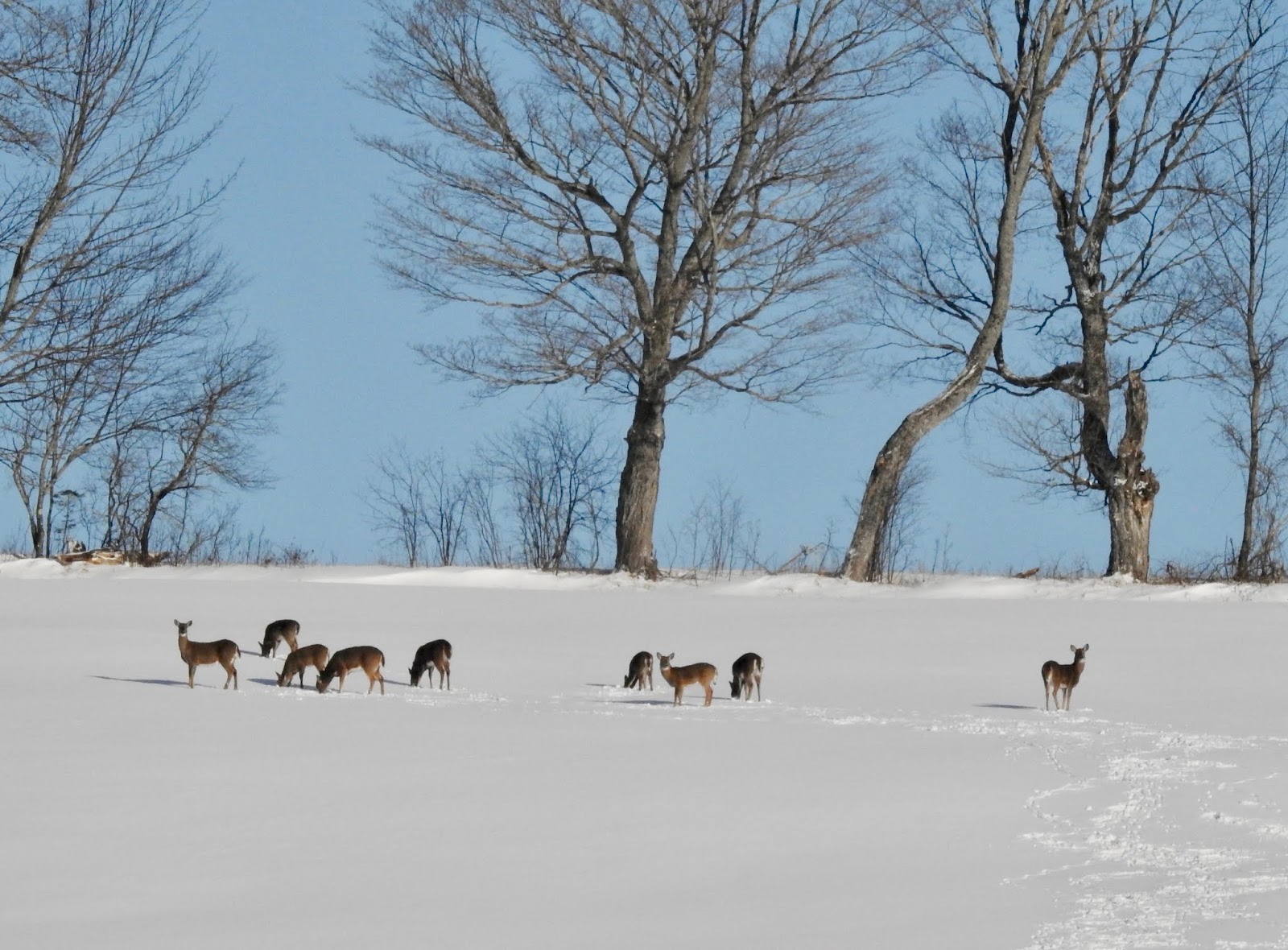
White-tailed Deer
Belted Galloway Cattle
Doing a Christmas Bird Count is hard work but it has many benefits.  It is fun to be out early to see what birds and nature in general are doing.  The deer pictured above were far away but the sun was shining on them up a large rising field.  They did not spook because they were far enough away to be safe.  The Belted Galloway Cattle shown above were in a field near the road enjoying the sunshine.  This breed is not common in New Brunswick and made a nice photo in the brilliant sunshine.

The Mactaquac Christmas Bird Count is one of more than 50 done in New Brunswick each year between December 14 and January 4.  Many people participate and the data are accumulated nationally and combined with similar data from the US for analysis by experts.  The Mactaquac count has been done for many years by loyal participants and a few new recruits.  Many thanks to all!


[I would like to acknowledge the loss in 2019 of two of our stalwart birders, Shirley Sloat and David Myles.  Both were faithful participants in the Mactaquac Christmas Bird Count probably since its inception.  David was the compiler for many years.  They are sorely missed.]

Wednesday, January 1, 2020

Gray Squirrel

A gray squirrel offers a nice perspective on its incredibly bushy tail. I shot this one in the backyard, and squirrels around here have it pretty good. Feeders offer unshelled peanuts, all manner of other seeds, plenty of mast-bearing trees, and lots of good cover. Gray squirrel longevity probably increases in such suburban oases.

The longer one of these animals survives, the wiser it becomes, and the more likely it is to avoid detrimental factors such as predators. Gray squirrels can reach ten years of age or more in the wild, although such elders are surely rare. The animal in the photo did not reveal his age, but he/she looked fat and happy to me.

Sunday, December 29, 2019

Limpkin's rare journey from Florida to Ohio causes stir among bird watchers

A limpkin with freshly caught snail at Ottawa National Wildlife Refuge/Jim McCormac

Limpkin's rare journey from Florida to Ohio causes stir among bird watchers

December 29, 2019

NATURE
Jim McCormac

An amazing report crackled through the birding grapevine on July 6.

A limpkin was found at a small suburban pond in Orville in Wayne County. Birders fortunate enough to reach the site in time found it. Come dusk, the wayward oddity, which looks like a cross between a heron and a rail, flew into a nearby tree to roost for the night.

Many birders were on-site at the crack of dawn the following morning, myself among them. Alas, the limpkin had flown the coop. We searched likely habitats nearby, but no one could find the bird.

Why the excitement? In the U.S., the limpkin is known as a Florida specialty, rarely seen away from the Sunshine State. That is the northern limit of its breeding range. Limpkins occur south through the Caribbean, Mexico and Central America, and into South America.

Limpkins are largely nonmigratory, and records north of Florida are few. Most vagrants turn up in southeastern states near Florida: Georgia, the Carolinas, with a handful of Maryland and Virginia records. Astonishing is a trio of old reports from the Canadian province of Nova Scotia.

The same day the Orville limpkin was discovered, an after-the fact report came in via new birder Nannette Patrick. She found and photographed a limpkin near Mentor, east of Cleveland, on July 3. Then, in mid-October, longtime birder John Pogacnik found yet another limpkin in the same region.

In between the Mentor records, a limpkin appeared at Magee Marsh Wildlife Area east of Toledo. That bird stayed through fall and was widely seen. By October, the Magee limpkin was getting harder to find, until it appeared at the adjacent Ottawa National Wildlife Refuge on Nov. 16.

I visited the Ottawa limpkin on Nov. 18. It was a snap to find. Seemingly unafraid, it went about its business of capturing snails in a small patch of swamp woods. In between hunting escargot, it would rest and preen in close proximity to a small knot of fawning birders.

If all of these records pertain to different individuals, it would constitute a mini-invasion of four birds, in a state where none had ever been recorded. Furthermore, they represent the farthest north the species has been seen in the U.S. Another limpkin turned up in southeastern Illinois — the only other Midwestern record.

Limpkins feed almost exclusively on snails, and to a lesser extent small mussels, and in Florida and points south they favor large apple snails. The Ottawa bird also fed on aquatic snails, but a smaller species, perhaps in the genus Stagnicola. It was adept at finding them, and in a half-hour period, I watched it capture and eat more than a dozen.

What would prompt such an unprecedented northward movement of a largely sedentary southern bird? Perhaps the best explanation is linked to a tremendous limpkin population expansion in Florida in recent years.

The limpkin population was perhaps constrained by its preferred food, the native Florida apple snail. In the past decade, populations of at least four species of nonnative apple snails have flourished. Opportunistic limpkins took a shine to this new food source, and their numbers have skyrocketed.

A limpkin boom means more birds to wander. These “scouts” that turn up in far-flung regions might perish, as they presumably do not have migratory roadmaps hardwired into their DNA. But over time, it is likely that new populations will become established north of the current home range.

The only certainty with bird populations is change.

Naturalist Jim McCormac writes a column for The Dispatch on the first, third and fifth Sundays of the month. He also writes about nature at www.jimmccormac.blogspot.com.


Saturday, December 28, 2019

Yellow-breasted Chat

Yellow-breasted Chat Seen at Whitehead Island

Yellow-breasted Chat [Mark Morse Photo]
The Yellow-breasted Chat (Icteria virens) is a rare visitor to New Brunswick.  It is seen mainly along the Fundy coast and islands in the fall and into winter.  It is rarely seen inland.  We would normally have about 2 or 3 reports per year.  The bird shown above was seen 23 November and 2 and 3 of December on Whitehead Island, off Grand Manan.  

Even though the Yellow-breasted Chat is classified with the warblers, it looks different.  It is larger (19 cm/7.5 in),  has a very large bill, a long tail, and a much different voice.  Its most noticeable field mark is its brilliant yellow breast and throat.  Note also the olive gray upperparts and the white spectacles.  It often holds its tail high as seen in the photo above.  

The chat is a secretive bird and often hides in dense tangled vegetation.  The male, however, sometimes sings from an exposed perch.  Its song is extremely varied but can be a series of notes given repetitively in a decelerating manner.  It also makes liquid whistles and harsh rasping sounds.  It can also mimic other sounds.  It would make you think there were many birds hidden in that bush!

The Yellow-breasted Chat is the only member of the Icteria genus.  There has been a lot of debate over the years about where it should be classified.  Some have suggested it should be classified with the mockingbird family (mimicry) or with the tanagers (big bill).  But, DNA testing has placed Icteria with the wood warblers.  It just shows how malleable a species can be over evolutionary time.  

The breeding range of this species is most of the US and northern Mexico with a possible small area in southern Alberta and Saskatchewan.  It winters from northern Mexico south to Panama.  The population has been in decline over much of its range due to habitat loss and urbanization.  

Yellow-breasted Chat feeds on insects including bees, wasps, ants, grasshoppers and beetles.  It will also eat berries and wild grapes.  It builds its nest of bark, grass and leaves in a dense bush.  Three to six white eggs are laid and incubated 11 to 12 days by the female. 

This species has an interesting breeding display flight which most of us here in New Brunswick have not seen (since it does not breed here).  It hovers with slow, deep-flapping wings and dangling feet.  That must be a pretty sight with that brilliant medium-cadmium yellow breast flashing against the dark olive.  The Yellow-breasted Chat was first described by Linnaeus in 1758.  It is a species we would all want to see and record on our annual lists.