Sunday, August 11, 2019

Macrophotography Workshop! Dawes Arboretum, September 14

A blue dasher dragonfly in its entirety may not really qualify as "macro" material, but its eyes do.

I'm giving a workshop focusing on macrophotography on Saturday, September 14, at the fabulous Dawes Arboretum near Newark. It'll start at 9 am at the Red Barn with a PowerPoint program on the nuances of imaging small things. The lushly illustrated talk will discuss equipment such as lenses, extension tubes and flash, camera settings, composition, etc. Also plenty of tips for finding COOL SUBJECTS.

The Red Barn is conveniently located in the midst of a diversity of wonderful habitat, so all we need do is walk outside the doors to quickly locate our own COOL SUBJECTS. The sprawling grounds of the Dawes Arboretum are always a treat to explore, and we'll have a blast doing just that. We'll end the day around 3 pm.

Cost is a mere $30.00. I hope you can make it. Registration is required, and to do so click RIGHT HERE.

A tiny zabulon skipper glares at the cameraman from atop the bud of a swamp thistle.

Friday, August 9, 2019

Upland Sandpiper Family Seen

Upland Sandpiper Family Seen

Upland Sandpiper Adult
Last week (August 2) we visited the blueberry fields in the Pennfield area.  It was a hot, sunny day with a nice breeze, a good day to go birding in New Brunswick.  We were specifically looking for one of New Brunswick's rare summer residents,  the Upland Sandpiper (Bartramia longicauda).  Upland Sandpipers prefer open areas such as grassy fields, playing fields, blueberry fields, tallgrass prairies, airports, etc.  They are difficult to see, often with just their heads showing above the vegetation.  They sometimes perch on posts.  They sometimes bob their tails like some other sandpipers.  When they land they often hold their wings up high before settling down.  They do not seem to need to be near water like other sandpipers.  

Upland Sandpiper Adult
We looked for a long time for the birds which others had reported being present but as you can imagine it is difficult to see these secretive birds even though they are quite large (31 cm/12 in).  We were just about to give up and were returning from a long drive and careful searching through the area when we spotted a bird walking across the dirt road.  Stop!  We had the pleasure of watching a juvenile Upland Sandpiper sauntering across the road and stopping to play along the way.  That was nice!  The  bird wandered into the thick vegetation and disappeared.  Further searching revealed the adults nearby.  We could hear their discreet 'purring' vocalizations which seemed to be used to keep the family together.  We considered ourselves very lucky to witness this uncommon family.  It was easy to see why they are so hard to see.  They disappear into the vegetation very easily.

Upland Sandpiper Juvenile
The juvenile Upland Sandpiper looks much like the adult, as seen in the photo above.  They are less barred on the body and their heads are lighter in colour.  The individual we saw was a bit smaller than the adults.  It obviously wasn't done growing.  It certainly was unaware of the danger it was in as it wandered across the road.  

The normal breeding range of this species is a relatively narrow strip from Alaska southward across the southern prairie provinces into the mid-western states, across the area south of the Great Lakes into New England with a small area into New Brunswick.  We are on the edge of their territory so are lucky to see them at all.  They winter in South America from southern Brazil to south-central Argentina.  Since they have so far to go to their winter home, they will soon be leaving here, probably by mid-August.  They continue to use their preferred habitats on their migration so can be seen in fallow fields, sod farms and airports.  One wonders how they can make it through the maze of the busy US population areas.  

These are a beautiful species and I wish we had more of them.  They remind us of our need to protect more habitat for such species.  For more information on this species, see a previous post on this blog entitled, 'Upland Sandpiper'.

Tuesday, August 6, 2019

Yellow-fringed Orchid, and Butterflies

Last Thursday, August 1, I made an epic photographic foray into Shawnee State Forest. I really needed a hardcore solo shoot, and besides it was an 18-hour day (only had one day) and I can't find many photogs who will put up with such an agenda :-). Many interesting observations and images were made.

This vast southern Ohio forest is full of biological riches, and I had several primary targets in mind, not the least of which is featured here. The yellow-fringed orchids, Platanthera ciliaris, were just starting to flower, and I wanted to work some more on attempting to capture their pollinators.

Yellow-fringed orchid is staggering in its beauty. Seeing a meadow dotted with gorgeous spikes of orangish-yellow flowers is an amazing experience, and as always I spend time just drinking in the scene.

But before long, the photographic game was afoot. Swallowtail butterflies are the pollinators (moths may visit at night, but I don't know that firsthand). As these butterflies are big, and the orchid's flower spikes are large, I arm myself as I would for birds. I lug out a lightweight camo chair, tripod, and telephoto lens. In this case, the rig was the Canon 5D IV and Canon's stellar 400mm f/2.8 II, with fill flash from a Canon 600 speedlite. I select the most conspicuous of the orchids, set up 15-20 feet away, and await my quarry.

At one point, a male zabulon skipper, Poanes zabulon, chose "my" orchid as a lookout. Male zabs are feisty as can be, and often sit in a conspicuous spot from which they dash out at nearly anything that flies by. Hoping for females, I suppose. This skipper could not have chosen a showier perch.

A spicebush swallowtail, Papilio troilus, drops in for nectar. Yes! This is what I wanted. The butterfly's long proboscis, and ability to hover/perch, allows it access to the nectaries that are deeply imbedded in the base of the long nectar spurs. In the process of mining its sugary reward, the swallowtail pollinates the plant.

I saw other swallowtails - only spicebush, I rarely see other species - nectaring at distant orchids. That's somewhat frustrating - over here! over here! I feel like shouting - but chasing them madly about with camera is no way to operate. It's just likely to spook the butterflies, and rushing into position makes it tough to compose a nice image.

Better to set up out of the pollinator's sphere of awareness, in perfect light and on a prime plant, and let the subject come to you.

Sunday, August 4, 2019

Rare plants of Cedar Bog

A meadow full of fen indian-plantain, Arnoglossum plantagineum. The plant is an odd member of the sunflower family (Asteraceae), and is quite rare in Ohio.

I'm giving a talk this Saturday, August 10th at Cedar Bog, a legendary botanical sweet spot that is full of rare flora - and fauna. The program commences at 10 am, and following that and lunch, we'll step out the back doors of the visitor's center and onto the boardwalk. An easy foray along the freshly rebuilt boardwalk will produce all manner of interesting flora (and fauna).

All are welcome. Cost is a mere $5.00 if a Cedar Bog Association member; if not, it's $10.00. The hard working members of the Association do nearly all of the heavy lifting in regards to management of this incredibly important natural area, and proceeds benefit their work. Details are RIGHT HERE.

The striking grass-pink orchid, Calopogon tuberosus, one of several rare orchids at the "bog". Cedar Bog, per square foot, has perhaps the richest botanical diversity of any site in Ohio. Many species of plants officially listed as endangered, threatened, or potentially threatened occur here. Even many of the plants that aren't listed as rare, at least in the fen meadows, are quite uncommon in the state.

Sedges drive much of the ecology at Cedar Bog - which is actually a fen. This one, seen here in full flower, is twig-rush, Cladium mariscoides. A close relative is the sawgrass of the Florida Everglades.

Wand-lily, Anticlea elegans, a highly poisonous member of the lily family. While you wouldn't want to eat it, the plant is nice to look at.

Seen here in fruit, prairie valerian, Valeriana edulis (syn: V. ciliata) is probably the rarest plant at Cedar Bog, and it has quite a story particularly insofar as this site goes.

If you can make it out, we'll have a good time and see lots of interesting stuff. Details about Cedar Bog are RIGHT HERE.

Friday, August 2, 2019

The Cotswolds, England 2019

The heat this summer has discouraged me from doing frequent blog entries,
but now it's time to talk about my holiday in England.
I hadn't been back for three years and I was beginning to miss the unique atmosphere
of my home country!

The first part of my trip took me to the beautiful Cotswolds.
This is the area where my dad grew up with his parents and sister.
It is well-known for its rolling green hills and hedgerows
and houses and walls built in the beautiful honey-coloured Cotswold Stone.

I do love coloured front doors and was immediately attracted to this blue one in the photo above. 

Five-bar gates is another favourite
They're so welcoming as we look beyond them into gardens or fields.

I can't visit the Cotswolds without going to the village (though I believe they like
to call it a town these days) of Charlbury.
This is where my dad lived with his family and where he and his parents are buried.
I always take some flowers when I visit them.

Here is the familiar entrance to the lovely cemetery.
You can see a typical dry stone wall too.

Such a peaceful resting place with a view over green hills and grazing animals.

I think that I take a picture of this red postbox, set in the wall, every time I visit!
Behind the wall is the most beautiful garden in the village.

Full of roses and clematis and lavender and many other flowers.

The bees were very happy in this garden too.
The scent of the lavender was wonderful.
I even met the lady who lives here and complimented her on her wonderful garden!
She told me that she and her husband had retired here after working in London.

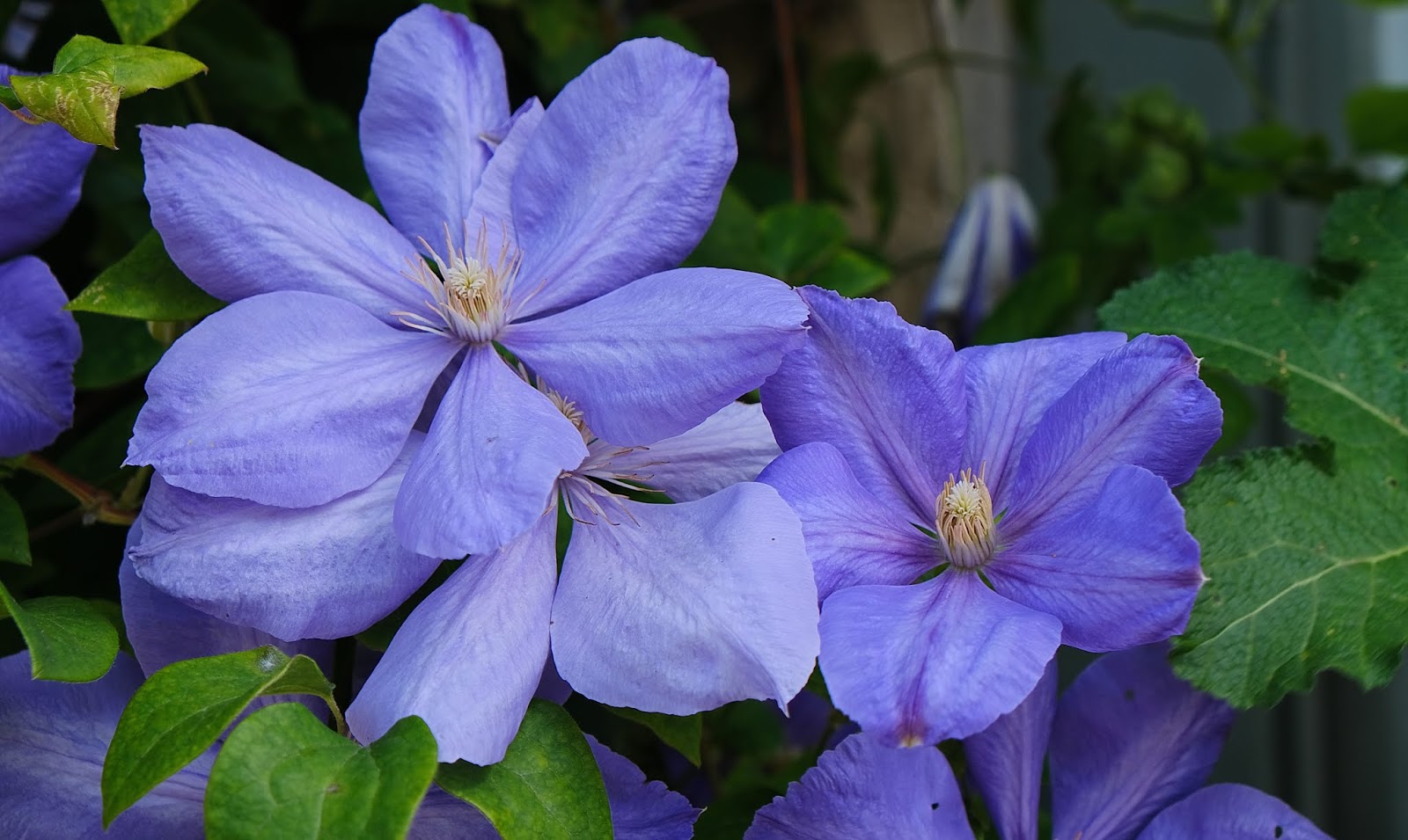
There are beautiful clematis in different colours against many of the houses.
This one is my favourite.

This one is my favourite.

We stayed in the small market town of Moreton-in-Marsh in the Evenlode Valley,
within the Cotswolds area in Gloucestershire.
The railway station on the Cotswold Line allows us to travel directly to London.
The journey takes about one hour and thirty minutes.

These colourful poppies were growing in the town.

We couldn't get to our favourite privately owned gardens opened to the public,
but you can see their beauty here:

I had got to know a fellow lady photographer through a photo site.
We decided to meet up in England where they live, not far from where we were staying.
Look at the fabulous view they have from their home!

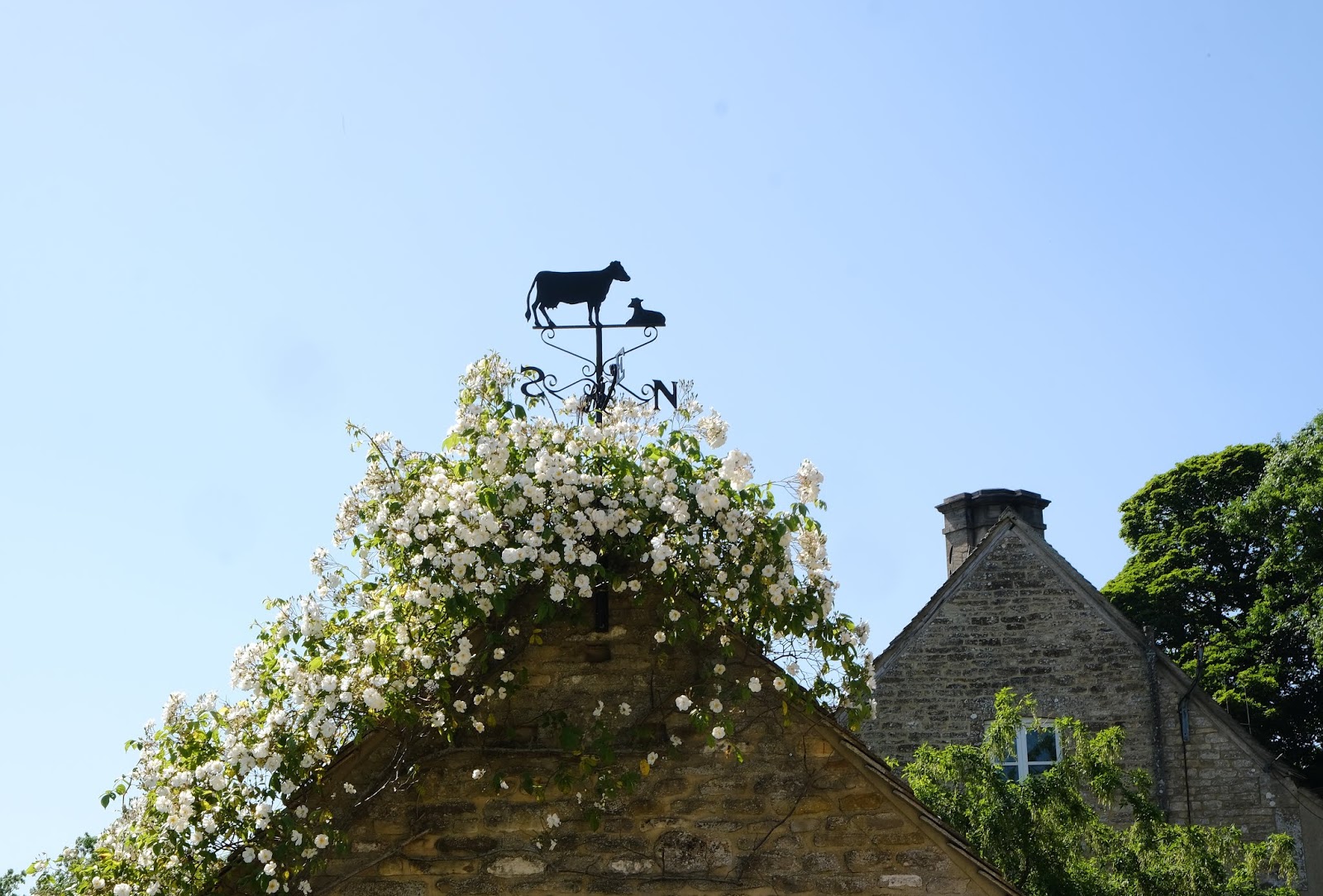
The weather-vane on their garage

The view from the living-room
What a dream place to live!

There are a few neighbouring houses, but they are not too close.
You do however need a car to get anywhere for anything you may need.
No village shops within walking distance,
but perfect for daily walks in an idyllic setting!

We visited a church in the nearby town of Northleach

I did like the plain glass windows with a stained glass effect from the trees
and greenery outside.

I did like the decorated cushions, handmade using tapestry stitches. 
Each one in a different design.

Here is the entrance to the Gothic style church of Northleach.

Northleach is a market town in the valley of the River Leach
also in Gloucestershire.

Hollyhocks and Cotswold stonework
is what I love the most when I go to England.

If you would like to see more of Hollyhocks and Honey Coloured Houses,
you can read about a former visit by clicking on the title above.

Next time, I'll take you to London, for that was the second part of my holiday!

I hope that you are having a beautiful summer!


Thursday, August 1, 2019

Spotted Sandpiper

A Fresh Water Sandpiper 

Spotted Sandpiper [Jennifer Ryder Photo]
The  Spotted Sandpiper (Actitis macularius) is a familiar shorebird to most New Brunswickers.  It is common along our rivers and lakes.  It is easily identified as a small shorebird with a spotted breast in breeding plumage and by its behaviour of bobbing up and down and teetering almost constantly.  It is North America's most widespread breeding sandpiper.  Its range is from Alaska to Virginia and from Labrador to California.  Its flight is unique, flying low over the water on jerky wingbeats.

Spotted Sandpiper
The Spotted Sandpiper's biology is interesting.  It manifests as reverse parenting roles.  The females arrive early and choose the nesting site.  The female defends the territory and chooses the male.  After the eggs are laid, the male assumes the chief parenting role including incubation. 

The Spotted Sandpiper nests along the shores of our lakes and rivers.  The nest is a ground depression lined with grass and moss.  Three to five green, pink or buff eggs spotted with brown are incubated 20 to 24 days.  The young are mobile soon after hatching and even start to teeter right away.  The diet of this species includes flies, grasshoppers, crickets, beetles, caterpillars, worms, molluscs, crustaceans, fish and spiders.  They often dip their food in water before eating.  

Spotted Sandpiper in Non-breeding Plumage
The Spotted Sandpiper in breeding plumage is easy to identify especially by its spotted breast, its teetering activity and also by the white crescent it shows at the anterior aspect of its folded wing.  The latter feature is helpful in identifying the species in its non-breeding plumage because it loses its spots in the fall and can easily be confused with other small sandpipers.  The call note of the Spotty (as it is often affectionately known) is easily identified (peet-weet).

The teetering of this species has been studied but its purpose has not been determined.  It gets faster when the bird is nervous and stops when the bird is alarmed, aggressive or courting.  Apparently the teetering does not impress the opposite gender!

Tuesday, July 30, 2019

Midwest Native Plant Conference 2019

Beautiful original artwork, courtesy of artist Ann Geise of Cincinnati, featuring the 2019 Midwest Native Plant Conference's conference plants: coral honeysuckle, Lonicera sempervirens, and wild bergamot, Monarda fistulosa. Keeping with the conference end goal of connecting flora and fauna, a hummingbird moth is included.

The weekend past saw the 11th iteration of the Midwest Native Plant Conference. As for the past ten years, it was held at Bergamo Center on the grounds of Mount St. John in western Greene County, Ohio. I don't see us moving the conference in the foreseeable future even though demand exceeds carrying capacity. The facilities are great, there is onsite lodging, and the 150 acres of grounds is rich in native flora and biodiversity.

We have a "problem" most conference organizers would envy. The event sells out within a day of registration opening. As we would like to be able to host everyone that wishes to attend, but can't, this year we re-jiggered some room logistics and were able to accommodate about 35 additional attendees. That enabled about 220 people to come, plus around 30 volunteers - the latter the lifeblood of this all-volunteer run event. The conference runs like a well-oiled machine and that's due to all of the wonderful people who work year-round and at the event to ensure things go smoothly.

Over the decade+ of the conference, we've raised over $100,000, which has been donated to Ohio-centric conservation causes, most of which are involved in acquisition and conservation of natural lands, such as the Beaver Creek Wetlands Association, Cedar Bog, and The Nature Conservancy.

This photo and the next two are from the Midwest Native Plant Conference's Facebook page.

The main hall in Bergamo Center is packed for one of our keynotes. We are fortunate in being able to attract outstanding speakers well-versed in the world of native flora. This year's slate featured Tavia Cathcart-Brown, Nancy Stranahan, Steve McKee, and Julie Zickefoose, plus a host of excellent breakout speakers. This year's complete speaker roster can be seen HERE.

The aforementioned Ann Geise, who has done our conference artwork since year one. She is also a conference vendor, along with many others and a raft of native plant vendors. Ann's obviously been hugely helpful to the conference, as has our planning committee, which currently consists of Yvonne Cecil, Alan Duffy, Lisa M. Ruschmann, Yvonne Dunphe, Ann Geise, Teri Gilligan, Scott Hogsten, Ned Keller, Randy Lakes, Diana and John Malas, Jim McCormac, Kathy McDonald, Cathy Plum, Joyce Pontius, Mike Shade and Debi Wolterman.

I would be remiss in not giving big thanks to the Native Plants in the Landscape Conference in Millersville, Pennsylvania. I've been going there to speak on occasion starting over 15 years ago, and it didn't take me long to ponder a similar event in Ohio. The Millersville conference is approaching its third decade, and is large, well run, and superb about promoting the importance of native flora - before many people were. Our original Midwest Native Plant Conference committee initially convened about 12 years ago, pulled off our first event the following year and the rest is history. An original committee member is Kathy McDonald and she has operated as our conference CEO ever since. She's the glue that binds the large complex event together.

A staple of the conference is vendors of native flora. The lane in front of Bergamo Center is lined with sophisticated sellers of natives, and attendees can find plenty of cool plants including species quite hard to find. On Saturday, we open the sale to the general public to further our reach and the sales of vendors' wares.

A big part of the conference agenda is field trips. We do nocturnal forays on Friday and Saturday nights, right on the grounds of Mount St. John. There are also diurnal excursions on all three days of the conference. Brother Don Geiger got this ball rolling decades ago when he started experimenting with native plants on the 150-acre grounds. Today the fruits of Don's labors is writ large, and within a short distance of the conference facility we can find all manner of interesting flora and fauna.

This is a last instar caterpillar of the cloudless sulphur, Phoebis sennae, noshing on one of its host plants, wild senna, Senna hebecarpa. It will become a big lemony butterfly with a tinge of green, and we find them here every year.

On Friday's nighttime field trip, we inspected a large path of Culver's-root, Veronicastrum virginicum, and were pleased to see the spires of luminescent white flowers covered with moths. Many moths are nectar-seekers and pollinators - we just don't notice them as much as we do their more conspicuous counterparts the butterflies. This stunner is a zebra conchylodes, Conchylodes ovulalis. Several were on these plants.

On Sunday, we conclude the conference with field trips to farther-flung places: prairies, fens, woodlands, home gardens and other interesting haunts. It's all a great time, and we'd love to have you there in 2020. Some very special speakers will be in the house for that one.

Go to the conference homepage, RIGHT HERE, and sign up for email bulletins. This is the quickest way to learn about news and events (we usually have one or two other mini-conferences annually), and most importantly to receive notification as soon as conference registration opens.