Wednesday, July 3, 2013

Troodon


The Life of Animals | Troodon | Troodon dinosaurs were small, up to 2.4 meters (7.9 feet) in length and up to 50 kg (110 lb) in weight. Troodon includes the largest known troodontids. Troodon had some of the largest known group of dinosaurs, in relation to its body mass (comparable to modern birds) brains. A brain to another Troodon volume ratio was 31.5% to 63% in the form of a reptile a bird action nonavian Real. Troodon had Crista support eardrums, that at least in their own regions dorsal and ventral ossified cartilage remaining sensitive parts of Troodon receive metotic The leg was "laterally hypertrophied." The type of sample Troodon has caused classification problems, because the whole genre is based on a single tooth of the Judith River Formation. Troodon tooth was like "lacertilian" (lizard), sorted by Leidy, but reassigned as 1901 Nopcsa megalosaurid dinosaurs (Megalosauridae were past'm a taxon for most carnivorous dinosaurs). In 1924, Gilmore suggested that the tooth belonged Pachycephalosaur and Stegoceras Stegoceras herbivores was actually a junior synonym of Troodon (the similarity of the troodontid teeth of herbivorous dinosaurs continues to lead many paleontologists believe that these animals are omnivores).


In 1945, Charles Mortram Sternberg rejected the possibility that Troodon was Pachycephalosaur because of its resemblance to the teeth of other carnivorous dinosaurs. With Troodon now classified as a carnivore, Troodontidae the family is no longer used to hold the mushrooms dinosaurs, so Sternberg appointed a new family for their Pachycephalosauridae.  Sternberg initially classified as family Stenonychosaurus Coeluridae. Later, Sternberg suggested in 1951 that the Stenonychosaurus had a "very special PES" and Troodon "equally unusual teeth" are closely linked. With Saurornithoides Saurornithoididae Family Foundation. Inequalis Stenonychosaurus reclassified grow and Pectinodon Polyodontosaurus bakkeri as junior synonyms of Troodon Formosus. Currie was also a junior synonym of Saurornithoididae Troodontidae. In 1988, Gregory S. Paul continued and generally Saurornithoides mongoliensis Troodon as T. Currie Classification troodontid all devices in North America only species Troodon formosus has been widely adopted by other paleontologists, and has invited all samples once Stenonychosaurus as Troodon in the scientific literature of the early 21 century reported.


In 1991, George Olshevsky Lance formation fossils, which was originally called Pectinodon bakkeri but also subsequently assigned to Troodon Troodon formosus bakkeri species and some others (including Currie) on its fleet of different dinosaur fossils as Troodon inequalis (ex Stenonychosaurus) Training maintain.  From the holotype of T. Formoso is a single tooth, which can make a nomenclature Troodon dubium.  Troodon Judith River Formation and the upper Two Medicine formation of Montana known. Judith River Group of Alberta, the Horseshoe Canyon Formation of Alberta and Prince Creek Formation of Alaska There is some evidence that Troodon prefer colder climates, since it seems particularly abundant in the north and the Arctic and also during colder intervals. A possible early Maastrichtian Troodon teeth is in the bottom of the Javelina Formation of Texas and member of the Kirtland Formation of New Mexico Naashoibito.


Dinosaur eggs and nests were discovered by John R. Horner in 1983 in Montana Two Medicine Formation. Horner (1984) found bones and partial skeletons closely hypsilophodont Orodromeus nests in the same horizon isolated and described the eggs as Orodromeus Horner and Weishampel (1996) re-examine the embryos in eggs obtained and were found not Troodon Orodromeus. Varricchio et al. (1997) took this decision with more certainty when they described a partial skeleton of a Troödon adult (MOR 748) in contact with a clutch of five eggs (MOR 750) in a position likely hatching Varricchio et al. (1997) describe the exact structure Troödon nests. Fuller nests were between 16 (minimum 246 MOR) and 24 (MOR 963) eggs. Varricchio et al. (1997) was insufficient evidence to draw several nests Troodon reproductive biology infer characteristics. Crocodiles lay many eggs that are small compared to the size of the adult body. The birds lay fewer eggs larger. Troodon was intermediate, lay an egg about 0.5 kg for a 50 kg adult. This is 10 times more than the reptiles of the same mass, but two Troodon eggs amounted to about 1.1 kg of eggs of a bird of 50 kg.  MOR 363 was 22 empty eggs (hatched) and embryos in the eggs of MOR 246 were found, are in development are very similar, which means that all young hatched simultaneously. The authors estimated 45-65 days total adult nest attendance for laying, incubation and hatching.


Varricchio et al. (2008) examined the bone histology of Troodon specimen MOR 748 and found that he had no reason to bone resorption may indicate that it was a female egg. They also measured the relationship between the total volume of eggs in Troodon clutches of body weight in adults. Use graphically the correlation between this index and the type of parenting strategies birds and crocodiles there and found that the proportion of Troodon compatible with those of the birds, where only adult male incubates the eggs was. They concluded that women Troodon probably not the hatching of eggs, men have done, and this can be shared between dinosaurs and basal birds maniraptoran characters.
Find The Life of Animals

Monday, June 24, 2013

Lies, Damned Lies and Propaganda


On the 16 June 2013, The Sunday Times under the headline 'Stress drives captive whales to kill trainers' published yet another sadly predictable and partisan article regarding the care of cetaceans in captivity.  The article focused primarily on the captive care of killer whales off the back of the recently released film "Blackfish" but also made more generalised comments on the welfare of cetaceans in captivity.

One particularly irksome comment was the erroneous claim that Britain has banned zoos from keeping whales and dolphins.


Such a specific claim is not new and maintained not only by members of the animal-rights industry but also by some zoo operators who one would hope would know better.


Notices displayed in the Brighton Sea Life Centre in 2009
A case in point being the Merlin Entertainments group owners of the Sea Life brand.  However, this may be in part to their somewhat bizarre position against cetaceans in human care and their close association with the anti-captive Whale and Dolphin Conservation lobby group and SeaLife's collusion in the infamous animal-rights led dolphin release project "Into The Blue".

In an exchange that pointed out this error, The Sunday Times journalist Jonathan Leake defended his position by stating that a DEFRA spokesperson had stated to him that:
“We [DEFRA] are concerned about the keeping of cetaceans in captivity and none have been kept in the UK since the early 1990s.  We believe that cetaceans are intelligent, social animals with complex needs that are unlikely to be met in captivity.”
This is a very surprising and ill-informed comment from a DEFRA spokesperson that appears to disregard the findings of their own commissioned report on to the welfare of captive cetaceans.

In 1985, the Department of the Environment (now part of DEFRA) commissioned biologists Dr Margaret Klinowska and Dr Susan Brown to research and review the keeping of cetaceans in UK zoos and aquaria. 

The report "A Review Of Dolphinaria" was published in 1986. The authors had the authority to recommend that cetaceans should not be held in captive care if their research supported such a position. However, it did not and they maintained that these animals could be successfully kept in animal collections given the right conditions. They stated
"...No substantial contra-indications to the keeping of cetaceans have been found which would not apply equally to the keeping of any other wild-caught animal...This is not to say that there are no problems with cetacean keeping, only that the problems are not dissimilar to those encountered in wild-caught animal husbandry in general, and could be solved...”
In 1986, a Steering Group of experts and officials was set up to review the recommendations of  "A Review of Dolphinaria" and after consultation with various interested parties in 1988 they published "Dolphinaria: Report of the Steering Group" which setup recommendations for the future welfare and keeping standards for cetaceans in UK animal collections to be implemented by 1993.

Since the publication of the new guidelines, no further official amendments or sanctions have been put in place regarding the welfare of captive cetaceans in the UK.

This was confirmed in May 2007 in an official response in the House of Commons by the Secretary of State for Environment, Food and Rural Affairs who stated:
"There are currently no cetaceans being kept in captivity in the UK, and other than for purposes of rehabilitation, there have not been any kept since the early 1990s. While it is not illegal to keep cetaceans in this country, the Zoo Licensing Act 1981 (as amended) aims to ensure that, should cetaceans be kept at an establishment for exhibition to the public, the establishment is licensed and the animals kept in accordance with strict standards relating to their health and welfare requirements. Those standards are set out in the Secretary of State’s Standards of Modern Zoo Practice and its supplement on the keeping of cetaceans in captivity. In addition to the requirements of the Zoo Licensing Act, all animals kept in captivity are subject to protection under the Animal Welfare Act 2006. We therefore have no plans to bring forward legislation to prohibit the keeping of cetaceans in captivity."
This position remains, as in the most recent edition of the Secretary of State’s Standards of Modern Zoo Practice published in 2012 the following statement regarding any future display of cetaceans in the UK states:
"Cetaceans have not been kept in UK zoos or aquariums for some years. The key references are Klinowska and Brown's Review of Dolphinaria."
Therefore, it can be clearly seen that the continued claims that the UK has banned the keeping of dolphins and whales in zoos and aquaria are false.  Moreover, extensive research by Klinowska and Brown found no reason why such a ban should be undertaken.


Wednesday, June 5, 2013

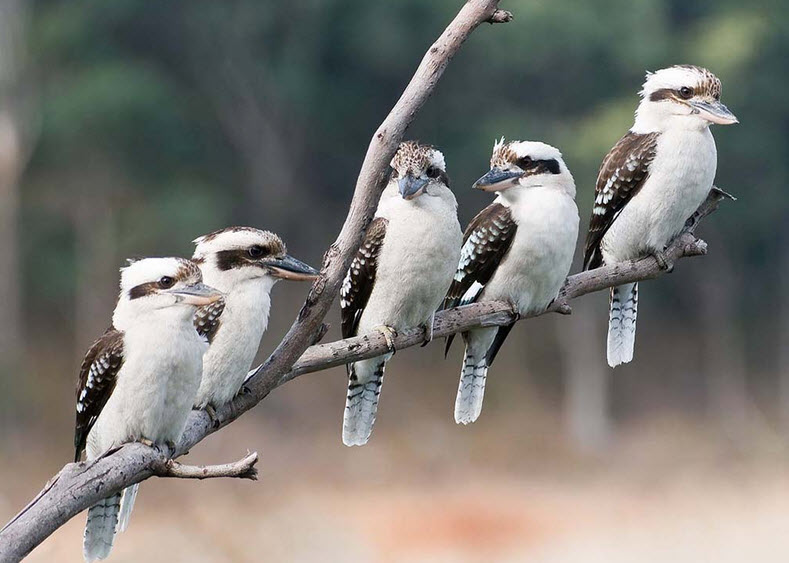
Laughing Kookaburra


The Life of Animals | Laughing Kookaburra | Laughing Kookaburra is native to the Australian mainland, and has also been introduced in Tasmania, Kangaroo Island and Flinders Island. Laughing Kookaburra is a stocky bird about 45 cm (18 inches) long, with a large head, a prominent brown eyes and Big Bill. Body with a white or cream-colored head with a dark over each eye and slightly above the head brown band. The tail is red-brown rust orange with black stripes and white tips on the feathers. The name "Laughing Kookaburra" means bird "laugh" is used to determine the area between family groups. Bird starts hiccups low laugh, then throws his head back and laughed often several others join in. If a rival tribe is within earshot and replies, the whole family meets before finishing laugh current ring. Hearing kookaburras in full voice is one of the most extraordinary experiences of Australian nature, something the locals can not ignore, and some visitors, unless forewarned, the call can be found surprising


Kookaburra is the theme song of the popular Australian children, Kookaburra. Kookaburras occupy forest land (including forests) released by family groups and their laughter serves the same purpose as other birds called its boundaries. Common prey includes small mammals such as mice and the size of large insects, lizards, small birds and chicks, and most famously, snakes. Small prey is better, but sometimes large kookaburras creatures, including much longer than its body venomous snakes. During mating, the Laughing Kookaburra provided as shown in the behavior as wattlebird. The man then offers his own current captivity, with "oo oo oo" sound. When food is abundant, parents spend more time black chick, so the girls are not able to fight. It is not uncommon for kookaburras snatch food from the hands of the people, without notice, falling away. People often fed pieces of raw meat. 

Find The Life of Animals

Monday, April 22, 2013

Morgan: No Damsel In Distress


Anyone who begins an article, which compares the slave trade to animals in zoological collections, could be said to be allegedly as morally bankrupt as the suggestion itself: also invoking Godwin's law with comments on Auschwitz are equally repugnant but sadly a disappointing reflection on the calibre of the below cited article. 


Nonetheless, slavery is exactly what Matthew Spiegl suggests at the beginning of his recent article in The Huffington Post regarding the care of killer whales at the US Sea World marine parks. 

See HERE

Of course, this is not the first time that human slavery and zoo animal care has been put forward. In October 2011, the People for the Ethical Treatment of Animals (PeTA) brought a case against the Sea World theme parks citing slavery and involuntary servitude under the 13th Amendment of the Constitution of the United States for five killer whales displayed at the parks.  The lawsuit failed and was dismissed.   Thus PeTA again exposed itself to ridicule from most right-minded people and the probable anger of many African Caribbean's who families were real slaves.
 
Spiegl's article was triggered by the news that the Sea World parks are to be floated on the US stock market and to promote yet another propaganda exercise by the animal-rights movement in the form of the film "Blackfish".

The article continues along a predictable course of an animal-rights advocate.  Sea World are portrayed as scheming villains with no good intent with his colleagues in the animal-rights industry portrayed as gallant knights, out to slay the ruthless dragon of commercial greed and free the damsel in distress. 

One particular damsel in this case is a young female killer whale that stranded on the Dutch coast starving and near death in June 2010.  The animal was rescued by the group SOS Delfijn and employees from Dolfinarium Harderwijk, which provided care for the animal at their facility in the Netherlands.  Due to the hard work and dedication of the parks staff Morgan (as she became known)  was rehabilitated but deemed unfit for release and moved  to live with a group of captive bred killer whales at Loro Park Tenerife, Spain in November 2011.

Details of Mogan's rescue and recovery can be found HERE.

Spiegl's argues for the release of Morgan but provides very little in the way of compelling or new evidence that would be appropriate to overturn original conclusion not to return her to the wild.

He comments that because Sea World were involved in giving advice in Morgan's rehabilitation this is something sinister but fails to understand that they would be asked as they are the leading specialists in the care and breeding of killer whales in zoological parks.

Moreover, his further citing of the movement of whales and dolphins between marine parks decades ago also has no contemporary relevance.  Neither is linking current animal acquisitions to Japanese and other drive fisheries, as Sea World displays no animals acquired in this way.  In fact, most animals displayed in the US and mainland Europe are from captive breeding.

Drive Fisheries and aquaria information HERE

More damning, Spiegl carefully leaves out the most recent evidence specifically regarding Morgan's health as specialist examination shows she is hearing impaired or deaf.  The reality of this finding is that she can never be released, as deaf cetaceans cannot survive in the wild environment.


Details HERE

Whilst Spiegl calls for a debate on these animals in captive care, his polemic is no more than special pleading for the position of his fellow animal-rights travellers and is not a debate at all as no alternative position is given.

Unfortunately, these discussions of animals as quasi-humans say little about the animals themselves - as they are not and never will be humans-  but say much about those promoting this position.  As always, these dialogues are about the human condition and the stark difference between the ideology of animal-rights and the promotion of animal-welfare.

As an "Ocean Advocate" Spiegl would be better placed to continue to promote such issues as plastics pollution of the ocean and sea environment that is a genuine danger to marine wildlife than the fate of a disabled whale living in a marine park.


Thursday, April 11, 2013

The leatherback turtle


The Life of Animals | The leatherback turtle | Turtles have the most hydrodynamic body design of a sea turtle with a large drop-shaped body. A nice pair of front flippers power the turtles in the water. Like other sea turtles, the leatherback turtle has crushed the front legs adapted for swimming in the open sea. The fins are the most important sounds in proportion to its body among sea turtles exist. Leatherback front flippers can grow up to 2.7 meters (8.9 feet) large sample size and large flippers (even in comparison to its body) of any sea turtle. Leatherback turtle covering her eggs, Turtle Beach, Tobago The leatherback has several characteristics that distinguish it from other sea turtles. Leatherbacks are unique among reptiles that fail in their scale β-keratinCounter-demonstration is the brightest in the turtle. Dermochelys coriacea adults average of 1 to 1.75 m (3.3 to 5.74 meters) carapace length, 1.83 to 2.2 m (6.0 to 7.2 feet) in length and weigh 250,700 kg (550-1500 lb). Surprisingly, the leatherback turtle is much larger than any other sea turtles hatch, since the transmission 61.3 mm (2.41 inches) carapace length and weighs about 46 g (1.6 oz) when newly hatched.


The first studies of leatherback metabolic rates found lute had predicted resting metabolic rate about three times higher than that of a reptile of their size. This creates constant heat swimming muscle derived. Adults were Lute with the body temperature of 18 ° C (32 ° F) floating above the water found in. Leatherback turtles are one of the creatures of the deep sea diving. The 1992 edition of the Guinness Book of Records presents the leatherback turtle moving 35.28 km / h (21.92 hours miles) in water. The leatherback turtle is a cosmopolitan species with a global reach. There are three genetically distinct populations in the Atlantic Ocean, the eastern Pacific and western Pacific Ocean. While nesting beaches have been identified in the region, leatherback populations in the Indian Ocean are generally not assessed and weighted. The leatherback turtle population in the Atlantic beaches of the region. Unlike other turtles, feeding areas for leatherback turtles are in colder waters, where there is plenty of jellyfish prey, which extends its range. However, few beaches on both sides of the Atlantic provide nesting sites. Overlooking the Atlantic coast of Canada, leatherback turtles feed in the Gulf of St. Lawrence near Quebec and as far north as Newfoundland and Labrador.


The beaches of the National Park Mayumba Mayumba, Gabon host the largest nesting population on the African continent and probably in the world, with about 30,000 turtles visit the beaches every year in April. Looking north-east coast of South America, varied selection of some of Guyana and Suriname are the most important sites for nesting of several species of sea turtles, the leatherback turtle, for the most part. A few hundred nest annually on the eastern coast of Florida. In Costa Rica, the beaches and nesting sites Parismina Gandoca. Pacific leatherbacks divide into two populations. Forage is the population of the South Pacific in the world, in the waters off the western coast of South America, nesting in Mexico, Panama, El Salvador and Costa Rica. The continental United States offers two major leatherback feeding areas. Further north on the Pacific coast of Canada, leatherbacks visit the beaches of British Columbia.


Rantau Abang beach Terengganu, Malaysia, once the largest breeding population of the world, home to 10,000 nests per year. Conservation efforts began in 1960 were ineffective because they are exposed to the excavation and incubation of eggs in artificial places accidentally eggs high temperatures. And 'well known that in 1980 that sea turtles are sex determination depends on the temperature, but it is suspected that the younger women incubated artificially In 2008, two turtles nest in Rantau Abang and, unfortunately, eggs were infertile.The leatherback turtle is found mainly in the open sea. The lute follow their jellyfish prey throughout the day, that the turtles "prefer" the deeper waters during the day, and the shallow waters at night (when the jellyfish in the water column), this strategy is often. Turtle hunting in very cold water An individual was actively hunting in waters whose temperature is 0.4 ° C (32.7 ° F).


Beaches favorite breeding places of the continent is facing deep water and they seem to avoid the sites protected by coral reefs D. Leatherback turtles adults feed almost exclusively on jellyfish. Due to the nature of the force-feeding, helps to control the populations of jellyfish leatherback turtles. Pacific leatherbacks migrate more than 6,000 miles (9,700 kilometers) across the Pacific from their nesting sites in Indonesia to eat California jellyfish. One of the reasons for their state of emergency in plastic bags floating in the sea of plastic bags by mistake lute Pacific jellyfish, took about a third of adult leatherbacks plastic. Plastics in the ocean off the west coast city where leatherback turtles, California, with power increase of 19 billion plastic bags per year. Several species of sea turtles ingest marine debris especially plastics, and even small amounts of debris can kill sea turtles by obstructing their digestive tracts. Dilution of nutrients, if the food move plastic intestine, according to the gain of nutrients and growth factors occurs so turtles. Like all sea turtles begin, the leatherback turtle, so that the miners of the sand of their nesting beaches. Leatherbacks are many predators and the first years of life. Once at sea, lute teenagers still eat cephalopods, requiem sharks and diversity of large fish. Nesting females were looted by jaguars in tropical America. Apparently, adult leatherbacks is aggressively defended by predators. Dermochelys young people spend more time in tropical waters than adults.


With offspring with special benefits While other species of sea turtles almost always return to their hatching beach, leatherbacks may choose another beach area. Nesting beaches and the angle of inclination of the deep sea is a vulnerability for the turtles because such beaches easily erode. The nest environment typically includes a dark wooded area near the beach. Females excavate a nest above the high tide line with their flippers. About nine days between nesting events. Clutch size averages about 110 eggs, of which 85% were viable. The eggs hatch after 60 to 70 days. Like other reptiles, the temperature of the nest determines the sex of the offspring. Dig evening, infants in area and walk towards the sea Leatherback nesting seasons vary by location, but occurs from February to July in Parismina, Costa Rica. Farther east in French Guiana, nesting from March to August The Atlantic leatherback nest from February to July in South Carolina in the United States Virgin Islands in the Caribbean, Suriname and Guyana. People around the world still gather sea turtle eggs. In Southeast Asia, egg collection resulted in countries like Thailand and Malaysia to a near-total collapse of local nesting. In Malaysia, where the turtle has practically disappeared, the eggs are considered a delicacy. In Birds, small mammals, and other opportunists dig up the nests of turtles and consume eggs. Shorebirds feed on crustaceans and sea battles in infants. Leatherbacks are a little 'less than other types of anthropogenic threats sea turtles. The nests are attacked by humans in places such as Southeast Asia. Many human activities, indirectly Dermochelys populations. As a pelagic species, D. coriacea is occasionally caught as by-catch. Since the larger devices EXCLUDER turtle sea turtles, life can be ineffective with mature adults. High levels of phthalate was measured in the egg yolk "
Find The Life of Animals

Monday, April 1, 2013

Grasshopper


The Life of Animals | Grasshopper | No coherent distinction between taxonomic species of locusts and grasshoppers, the basis for the definition of a species swarm form under appropriate intervals. In English, the term "locust" is used for the grasshopper species which are morphologically and behavioral change the movement, the formation of clouds that grow immature stages called bands hopper. Charles Valentine Riley and Norman Criddle were also involved in the development of understanding and control locusts. Research at Oxford University has discovered a swarm behavior is a response to overcrowding. This causes the locust to change color, eat much more, and much easier to raise.


Locusts in the Bible and the Qur'an, one of the biblical plagues of Egypt, where locusts ate all the crops of Egypt. In an article published in the January 30, 2009 edition of the AAAS Science Journal, Anstey, Rogers, et al. demonstrated when locusts are, their nervous systems release serotonin so attracted to each other, a prerequisite for swarming. Swarms of locusts have short antennae or antennas and auditory organs in the abdomen (posterior segment of the body). From winged adults fly in swarms, locusts may be carried by the wind hundreds of miles from their spawning grounds, landing devour all vegetation. The migratory locust (Locusta migratoria) from Europe to China, and even small swarms may cover several square miles, and weigh thousands of tons.


The largest known swarm covered 513,000 km ², comprising about 12.5 trillion insects and a weight of 27.5 million tonnes. A biological pesticide for the control of locusts in Africa has been tested by a multinational team in 1997. Dried fungal spores sprayed in breeding areas Metarhizium species pierce the locust exoskeleton on germination and penetration of the body cavity, causing death. The fungus is spread by insects and insect persists in the region, making repeated treatments unnecessary.


The extinction of the Rocky Mountain locust is a source of wonder. The international agenda is LUBILOSA promote non-chemical methods of control to find lobster. Different cultures around the world eat insects. Even Islamic law and Jewish food, eating other insects grasshoppers to eat after the ban, particularly as food for the hungry poor.
Find The Life of Animals

Wednesday, March 27, 2013

Tasmanian Devil


Beauty Of Animal | Tasmanian Devil | As funny as it was, the familiar Looney Tunes portrayal of a Tasmanian devil, gurgling growl, insatiable lunatic is, at times, not all that far from the truth. Tasmanian devils have known cantankerous disposition and will fly into mad mad when threatened by a predator, fighting for a mate, or defending a meal. The early European settlers dubbed the "devil"