Monday, September 23, 2019

Hemphill House, Adams County, Ohio

The Hemphill House, Adams County, Ohio.
(Click the photo to enlarge, as always)

I spent the weekend in Adams County with about 20 friends, canvassing interesting habitats for flora and fauna. We found scads of stuff, and I'll share some of those organisms here, later.

Last Saturday, the group journeyed to a wonderful spot on the banks of the Ohio River, where we located our primary quarry, the amorpha borer beetle, Megacyllene decora. Many other notable finds were made as well. The northbound return trip took us up a winding country lane that I haven't been on in years. Our car caravan crested a low ridge, and the old homestead in the photo suddenly presented itself.

Whoa! I hit the brakes to marvel at the beautiful old stone house, until I remembered I was the point car and had the caravan backed up in a less than safe spot. Off we went, but I resolved to return early the next morning for photos, and did just that.

It turns out that the structure is the Hemphill House, named for James Hemphill. If I've got the history correct, he bought this property in 1805, and probably constructed this house shortly thereafter. Hemphill was said to be a man of means, with much of his wealth derived from his regionally renowned whiskey distilling business.

The house is built like a bank vault. Thick stone walls have allowed the structure to withstand the test of time, and still look solid and nearly inhabitable. Judging by the newer roof, I'd say people did continue to use the house well into the 20th century. I didn't try to enter, of course, but I imagine the inside is probably beyond repair. Nonetheless, the house still stands strong, and I suspect its shell will remain for some time to come.

Sunday, September 22, 2019

Zermatt in September 2019: Part 1

The star of Zermatt is the beautiful Matterhorn mountain.
This was taken from above the town from a lovely restaurant in the mountains.
I really like the way they have arranged bottles of flowers on high ledges
 in front of this marvelleous view.

But first of all, we'll visit the town before going up into the mountains for a hike.
Switzerland is well known for its beautiful arrangements of geraniums
and they're particularly beautiful on the wooden chalets.

Here is the hotel we stayed in which is very near the small centre,
but just on the other side of the River Matter Vispa that runs through Zermatt.

A pretty garden in a side street.
You can see the dome of the museum on the upper right.

From the balcony of my hotel room
I could see the Hotel Julen in typical darkened and weathered wood
which shows off the window boxes of flowers so well.
This was taken in the early morning.

Another chalet adorned with flowers and even a pair of mountain boots.

The Zermatterhof is a beautiful hotel in classical style.
This is where my son and his bride stayed last year in August
 and it's where the wedding reception was held.
Here is the link if you would like to see it:

The church steeple of St. Mauritius.

This plaque in the main street is to honour the first man to successfully reach
the summit of the Matternhorn with two guides.
It was a dangerous ascent and the equipment was rather rudimentary.
You can read about it here:

On the second day of our stay, we took a funicular up to a station called Sunnegga.

This is the view that greeted us!
You can see the glacier on the right of the image.

We took a small path down to a little hamlet called Findeln.
The cows were still grazing at this high altitude of 2.288 metres.
Soon they will be leaving the mountains to descend down the valley
for their winter quarters.

When we arrived in Findeln, we headed for a wonderful restaurant, called Chez Vrony,
 with fabulous views and a welcoming outside terrace.
The long wooden tables and white parasols make it perfect to sit outside.

Isn't it inviting?

The view is pretty marvellous too.
This is where we had our after lunch coffee.

Inside the chalet restaurant looking out over the sunny terrace.
It must be so snug for skiers here in the winter!

Here are Vrony and Max, the lovely owners of this restaurant.
They kindly allowed me to photograph them.

Here is a typical chalet on stilts used for storing grain.
The large discs of stone prevented rats and mice from climbing into the building
to eat the stored cereal.

When we could tear ourselves away from the lovely terrace and delicious organic food,
we started our descent down the valley.

Another chalet in the same Findeln Hamlet.
The pathway down was quite steep, but the views were fabulous all the way.
If you would like to see more mountain shots,
come back at the end of September when I'll be doing the next blog entry!


I just added this colourful collage to wish you all a very happy
Autumn Equinox
on Monday 23 September!

Thursday, September 19, 2019

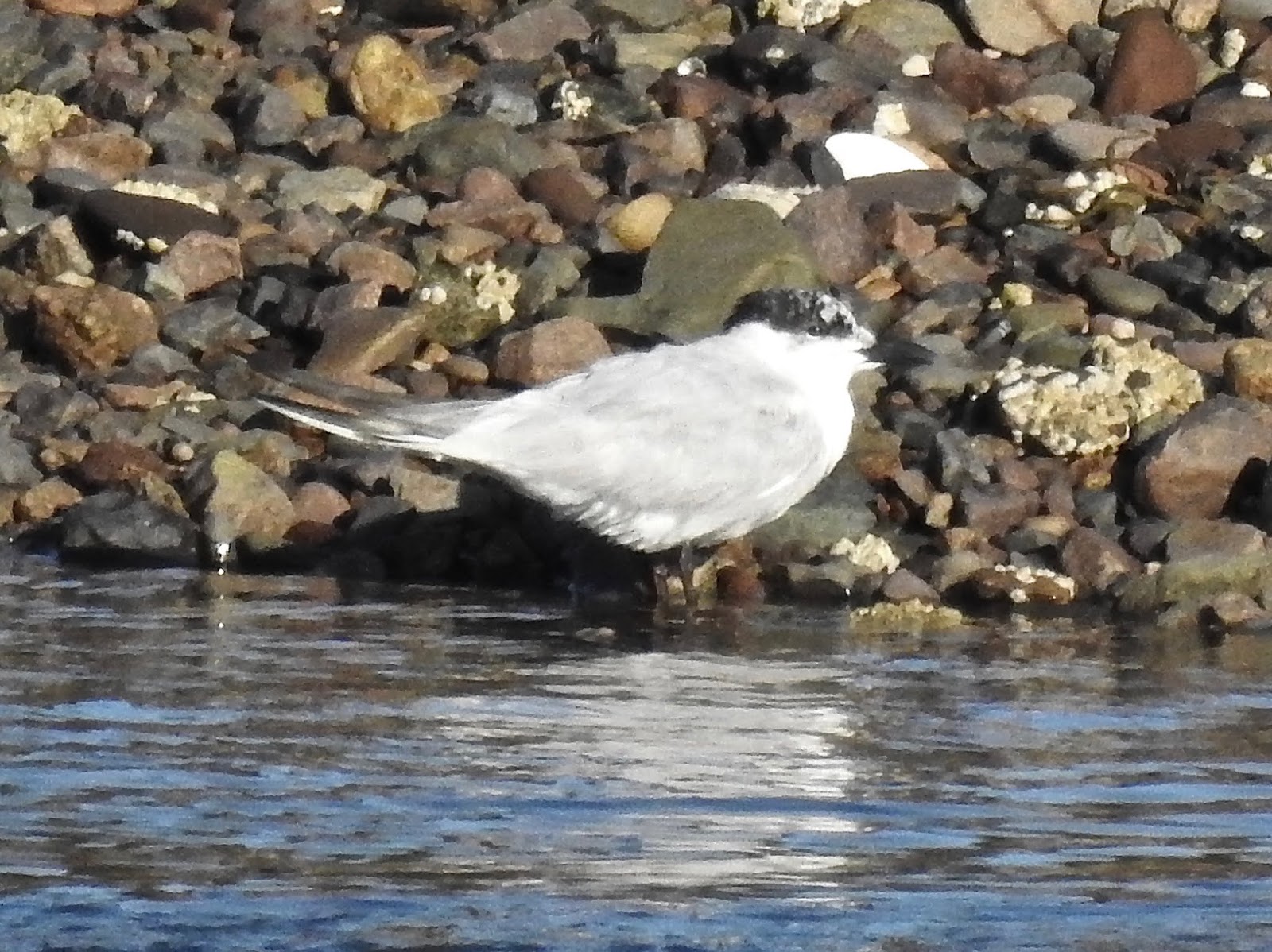
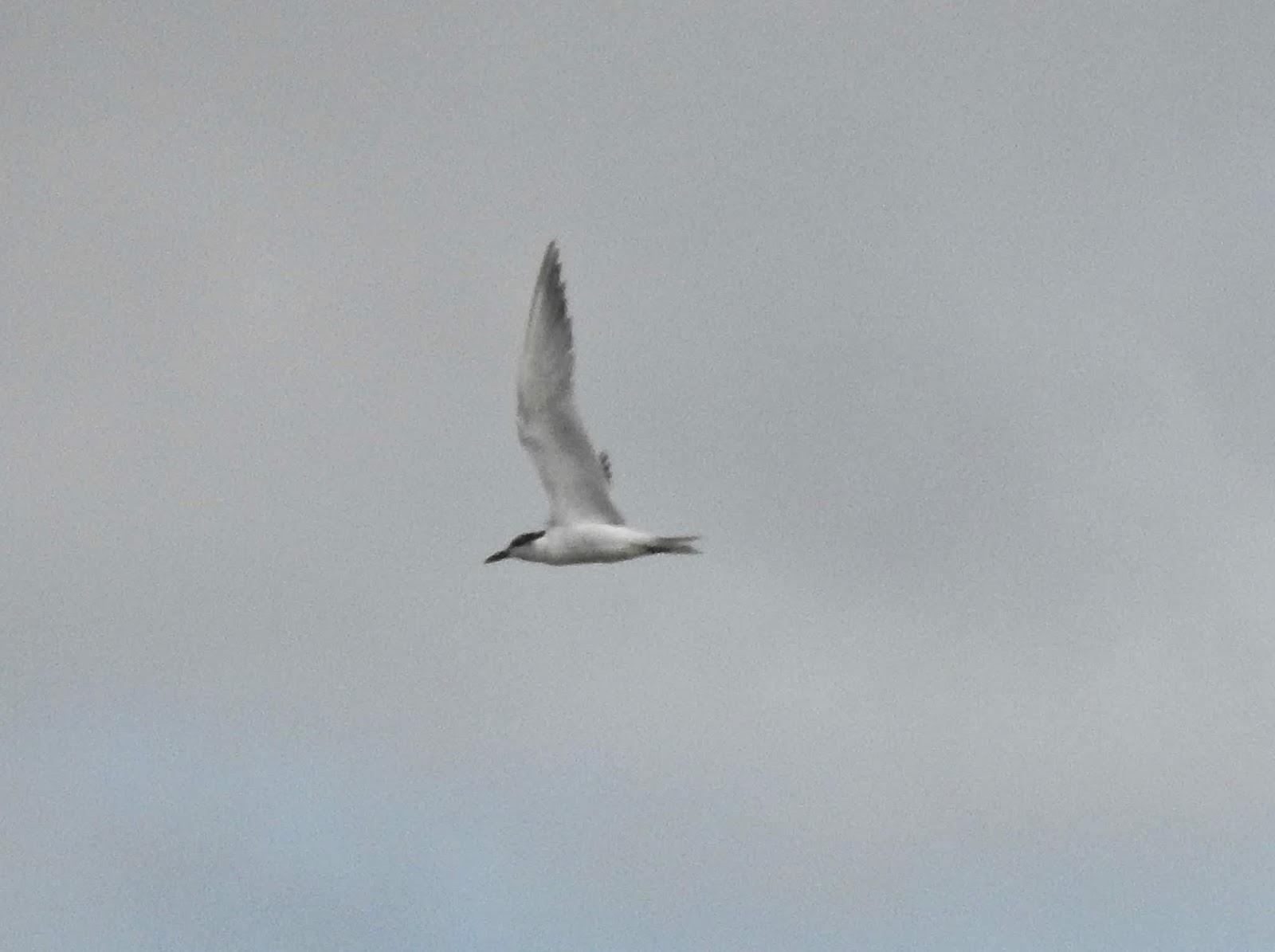
Gull-billed Tern

Hurricane Dorian Brings Ultra-Rare Birds

Gull-billed Tern 
The Gull-billed Tern (Gelohelidon nilotica) is an ultra-rare visitor to New Brunswick.  The recent bird was found at Maces Bay and has remained for a few days.  It is listed as 'accidental' in 'Birds of New Brunswick:  An Annotated List'.  In short, it appears here extremely rarely and only after severe storms.  Our recent avian visitor was blown here by hurricane Dorian.  It was caught in the hurricane and blown way off course and carried by the severe winds northward.  It must have been exhausted when it arrived.  One wonders how long it was suspended in the storm before it could get to land.  
 
The Gull-billed Tern has been seen here before.  The first recorded specimen came from Grand Manan in 1879.  Most other records came from the Grand Manan area but there also have been reports from Red Head Marsh in 1983 and Eel River Bar in 2003.   The normal breeding range of this species is the coastline of eastern and southern US.  In the winter it is found along the coasts of southern Florida, Texas, Mexico and Central America. 

Gull-billed Tern
Terns are members of the Laridae family along with gulls and skimmers.  Terns are generally smaller than gulls and have straight pointed bills and long narrow wings.  Most have a black cap in breeding plumage.  Most terns eat fish but the Gull-billed Tern in unique in that its diet is mainly insects and some prey from the water's surface like crabs.  It never plunges for prey like most terns.  Our visitor was swooping over a small field beside an inlet off the Bay of Fundy feeding heavily on grasshoppers and other insects.  It reminded me of a very large swallow, the way it swooped and turned abruptly as it caught its prey.  

The Gull-billed Tern is very light in colour.  Its plumage is a very light gray.  The wings are light underneath with some graying near the tips.  The legs are black and the black cap on this individual was turning light in the front aspect as it was showing winter plumage.  The outstanding field mark of this species is its stout black bill, hence its name.  The bird is 36cm/14 in. long and it has a wingspan of 90 cm/ 36 in.  Its white tail is notched and it showed this off well as it wheeled and turned near us.  The only other species we would have to differentiate it from is the Forster's Tern which is smaller, slenderer, and has more pointed wings and a deeply forked tail.

Gull-billed Tern
Gull-billed Terns are colonial or solitary breeders.  They often nest on the periphery of the colonies of other species of terns.  They nest on the open ground and the nest is often hidden among the debris on the shore of coastal beaches or saltwater marshes.  One to four yellow or buff eggs spotted with dark brown are laid and both adults incubate the eggs.  

Gull-billed Tern Showing Tail Shape and Long Wings
The population numbers of Gull-billed Terns has declined along the Atlantic coast.  Historically the millinery trade in the 1800s took its toll on this species.  However, this species is in good population numbers globally.  It is also found in Australia, Europe, Asia and Africa.  From our point of view, the sighting of this rare species in New Brunswick is a noteworthy event and made many birders happy to watch it for the first time.

Wednesday, September 18, 2019

Macrophotography at Dawes Arboretum

Looking stunning against the pure blue sky of a fall Ohio day is this purple swamp aster, Symphyotrichum puniceum. There are over 35 native aster species in the state, and they all make for great photo subjects.

I led a macrophotography workshop at Dawes Arboretum last Saturday, September 14. The 15 spots filled quickly, and we had a great time exploring the grounds of this state treasure. Following a presentation about various macrophotography techniques in Dawes' "Red Barn", all we had to do was step outside the building to immerse ourselves in a macro wonderland. All of the subjects shared here were taken within sight of the barn.

If you've not been to Dawes Arboretum, I'd recommend a visit. The grounds encompass about 2,000 acres, and about half of the property contains more formal plantings and gardens, while the remainder is natural landscapes. The place is a gold mine for photographers, and I believe we will repeat this workshop next fall.

A bit of nocturnal scouting the night before yielded some excellent larvae, such as this Pandorus sphinx moth caterpillar, Eumorpha pandorus. As is often the case, the boldly spotted cat was found on straggly Virginia creeper plants at the base of a tree. I temporarily detained this cat and a Luna moth caterpillar, and shared the tubular livestock with everyone on Saturday. Many images were made, and the cats were later released where they were found.

OMG! This is a Holy Grail of spiders and only the second one that I've seen. It is a toad-like bolas spider, Mastophora phrynosoma, and we found this one low in the boughs of a sugar maple. There was an enormous hatch of bronzed cutworm moths, and they were resting on tree foliage everywhere. I think that's what the victim here is. Bolas spiders are incredible, producing pseudo-pheromones to lure male moths into their sphere. Gullible moths are then snared and reeled in with the equivalent of an arachnid fishing line. You can see more photos and read about these amazing spiders RIGHT HERE. Unfortunately, I could not capture this one for the group to see/photograph the following day. To do so would have messed up her operation, and besides to really see the magic of a bolas spider, one must see them on their terms after nightfall, when they are hunting.

Everyone could and did see and image this spider, one of many of its kind that we saw. It's a banded garden spider, Argiope trifasciata,  and this was a particularly compelling composition for us. The huge female lays in wait in her web, while two males attend her, at a safe distance. The disparity in size between the sexes is stunning. The males' comparative puniness makes mating a risky business. If he makes a misstep, she's liable to seize, kill, and eat him. I don't know what happened to the male at right center. He's missing four legs, but is still hanging in there.

Everyone was pleased to see and photograph this golden tortoise beetle, Charidotella sexpunctata. A specialist of plants in the morning-glory family, the "gold bug" is an amazing creature. When stimulated, it can change color by forcing liquid through tiny grooves in its opaque shell. Beetles will shift to reddish or orange hues, often while mating. As a point of trivia, the longest recorded copulation in this species was 583 minutes.

A showy little short-winged meadow katydid, Conocephalus brevipennis, patrols the flora like a six-legged wandering minstrel. This is a male, and he sings with his wings, rubbing them together to create a song that attracts females. Meadow katydids are near their peak right now, and their sputtering trills are a big part of the insect soundscape.

I have long wanted this shot, and got it during the workshop. A spring peeper, Pseudacris crucifer, basks in a pool created by the fused leaves of cup plant, Silphium perfoliatum. The basket-like basal portions of the plant's lower leaves hold water, and I figured someday I'll find a frog in one of these. Well, that didn't happen at the workshop, so we placed this peeper - which Becky Donaldson found nearby - into the cup plant. The frog seemed happy in his moist environment on this hot day, and so were my fellow photographers. It was a great way to conclude the workshop.

My thanks to Greg Payton of Dawes Arboretum for conceiving this workshop, and inviting me to participate. Also to Becky Donaldson, the naturalist at Mentor Marsh (see this RECENT ARTICLE) who was hugely helpful in finding subjects and sharing her vast knowledge of critters great and small.

Tuesday, September 17, 2019

Photo-wonky stuff: Teleconverters

As always, click the photo to view at full size

A white-eyed vireo whisper-sings as he works through a dense snarl of vegetation. I made this image yesterday morning in Hocking County, Ohio, before the sun had fully illuminated the vireo's shady haunts. Experienced photo critics will notice the flaws in this image, perhaps most notably the graininess. Even at a low shutter speed of 1/400 - given the lens I was using and the bird's movement - I was still at an ISO of 3200 - far higher than I'd want. Good noise reduction programs can't completely vanquish digital noise. Even with excellent full frame cameras, I really don't like the ISO rising above 800, and 500 or lower is far better yet.

Low light and high ISO settings are not the point of this post, though. The lens and its accouterments is. I shot this with Canon's remarkable 400mm f/2.8 II, which is great for low light shooting and insanely fast at attaining focus and holding it. But 400mm is at the low end of reach insofar as birds go. Birds are often tough to approach closely, and oftentimes size matters. The bigger the lens, the better.

I have both 1.4x and 2x teleconverters (Canon version III). Teleconverters are stubby little magnifiers that can be quickly mounted between the lens and camera, and increase magnification by the power indicated on the converter. In this case, my 400mm lens becomes a 560mm lens with the 1.4x teleconverter, and obviously an 800mm lens with the "doubler" mounted. Voila! Like magic, we're in truly big lens territory, and much more able to hunt those bashful birds.

But few things come without cost. For sure, the teleconverters are WAY less expensive than are huge lenses, but they exact a different price. One, you're shooting through more glass - the teleconverters have internal lenses - and the more glass one shoots through, the more the image quality suffers. This deterioration, however, is almost negligible with Canon's 1.4x. It's more noticeable with the 2x, but still the image quality can be quite reasonable even with this super-magnifier. Probably a bigger burden brought on by teleconverters is the loss of aperture. With the 1.4x, you lose one stop, and the 2x causes a loss of two stops. So, with the 1.4x mounted on my 400mm f/2.8, I'm at f/4. With the doubler, f/5.6. If conditions are sunny and light is abundant, this may not be much of a problem - you can still use a sufficiently fast shutter speed, yet maintain a low ISO. In the case of this vireo, that wasn't possible.

For this photograph, I used the 2x doubler, giving me a much-appreciated 800mm.That got me in good working distance to my bashful subject. But at 1/400 shutter speed - what I felt was about the lowest I could go - it gave me that dreaded 3200 ISO. If the doubler did not cause a loss of two stops and I was able to shoot at f/2.8, my ISO would have been 800. But as I said, there's no free lunches.

In great light, especially, teleconverters are a fantastic tool for extending reach. I use the 1.4x all the time, and see nearly no downsides to it. Autofocus is nearly unaffected, the loss of a stop is almost never an issue - ideally, I like to stop down to f/8 or so if light permits - and image quality remains superb. It's nearly magic without strings.

The 2x is a different story, and I usually don't recommend them, as I and many others have found that attaining sharp focus can be difficult with one. Micro-adjustments are usually necessary, and even with such tweaking it can still be hard to make crisp images. Autofocus is lost on some lenses, and if it's still enabled, it's slowed significantly. I've only had one lens where I could just slap on the 2x and take consistently sharp images and that's the Canon 300mm f/4 (600mm with the doubler). Until I got this miracle-working 400mm. With no micro-adjusting, it took perfectly to the 2x teleconverter. Not only that, but autofocus remains incredibly fast, and images look sharp and clear, especially under good lighting.

If you want more reach for birds, it might be worth renting a teleconverter or two. If they mate well to your lens and you're happy with the results, a teleconverter(s) is well worth the investment. The recent Canon version III lenses - like the 400mm and 600mm - are the best yet at mating effectively to teleconverters. They'll only get better, too.

Sunday, September 15, 2019

Nature: Restoration of Mentor Marsh is magnificent

Naturalist Becky Donaldson has helped restoration efforts in Mentor Marsh, allowing native flora and fauna to make an impressive comeback/Jim McCormac

September 15, 2019

NATURE
Jim McCormac

On Aug. 13, I journeyed to the largest undiked wetland on the U.S. shores of Lake Erie: Mentor Marsh, just east of Cleveland. My guides were Becky Donaldson and Ben Piazza, Cleveland Museum of Natural History employees and on-the-ground marsh managers.

We hopped in an Argo “marsh buggy” and set off on a comprehensive tour of the 800-acre wetland. I have long been familiar with the marsh, but the changes that have been wrought in recent years are stunning.

Disaster struck in the 1960s, when tailings from local salt-mining operations leached into a nearby feeder creek. Salt might be good on fries, but it’s disastrous for freshwater marshes. The worst consequence of the salinity spike was invasion by an aggressive nonnative grass, Phragmites australis, or common reed.

The Eurasian grass is salt-tolerant, and it eventually cloaked nearly the entire wetland. Indigenous flora was choked out by the nearly impenetrable stand of 10-foot-tall bamboo-like plants, and biodiversity plummeted.

A Mentor Marsh strangled by Phragmites was all that I, and most of my contemporaries, knew. However, in a stunning reversal of fortunes, the Cleveland museum has orchestrated one of the most ambitious wetland restorations on the Great Lakes.

Beginning in 2004, common reed control was implemented. It was baby steps at first, but in recent years the efforts have grown tremendously in intensity. The varied management tactics include physical mashing and cutting, aerial spraying, and on-the-ground herbicide treatments.

I could hardly believe my eyes as Donaldson and Piazza shepherded me through the marsh. There was scarcely any common reed to be seen. Freed from the shackles of this infestation, native flora has resurfaced from the seedbank.

Dozens of native-plant species, some not seen in decades, dotted the marsh: pink mists of swamp milkweed, attracting migrant monarch butterflies; swamp rose mallow, with its gargantuan showy pink flowers formed thickets; brilliant magenta flowering spikes of swamp loosestrife — a native — bringing numerous butterflies.

Nearly 200 species of native plants have been documented, and most are far more prevalent now that the common reed has been removed. New finds are made every year, and Donaldson recently made a stellar discovery, the state-endangered northern wild rice.

The astronomical spike in floristic diversity has spawned a proliferation of animal life. We saw birds galore, including bald eagle, Caspian tern, common gallinule, osprey, Virginia rail, wood duck and many others. Fish such as pike and yellow perch have returned, and beaver and river otters are occasionally spotted.

A healthy marsh is a boon for the Cleveland region, attracting scores of natural-history enthusiasts from far and wide. Lake Erie water quality is better, and visual appeal for local residents is enhanced. The threat of blazes that erupted periodically in stands of incendiary common reed has been eliminated.

Many partners have played a role in Mentor Marsh’s recovery, including the Great Lakes Restoration Initiative, National Fish & Wildlife Foundation and U.S. Department of Agriculture. Dan Donaldson of the Lake County Soil and Water Conservation District was especially helpful in implementing restoration practices.

But the catalyst for this success story is the Cleveland Museum’s Natural Areas Program and its visionary leader, Jim Bissell. He and his staff — Donaldson, Piazza, David Kriska and others — have done the heavy lifting.

Mentor Marsh was Ohio’s first state nature preserve, dedicated in 1971. Kudos to the Cleveland Museum of Natural History for working to return it to its original splendor.

For more information, visit www.cmnh.org/mentor-marsh.

Naturalist Jim McCormac writes a column for The Dispatch on the first, third and fifth Sundays of the month. He also writes about nature at www.jimmccormac.blogspot.com.

Thursday, September 12, 2019

Hooded Warbler

Rare Birds in Grand Manan

Hooded Warbler [Mark Morse Photo]
Late summer and fall usually bring us a few rare bird species.  Those species are often seen along the coast and especially on Grand Manan.  The recent hurricane Dorian has brought some incredibly rare species to Nova Scotia and a few to New Brunswick.  The Hooded Warbler of today's post was seen on Grand Manan in late August (pre-hurricane) and represents one of the species that seem to get off-course in their southerly migrations. 

The Hooded Warbler (Setophaga citrina) is a startlingly beautiful warbler.  The male in spring sports a black hood which covers its throat, crown and nape.  The hood contrasts with the bright yellow face and forehead.  It has an olive-green back and rump and yellow underneath.  The legs are pink and it has white outer-tail feathers which it uses to 'flash' a potential predator.  The breeding-plumaged female is a paler version of the male with variable amounts of the hood.  

The Hooded Warbler prefers shady undergrowth in mature hardwood forests when it is in the north.  The species is unusual in that the two genders prefer different habitats on the wintering grounds.  The males prefer mature forests but the females prefer scrub land. The normal range of this species is the southeastern US in summer and southern Mexico and the West Indies in winter.  It is a super flier, migrating across the Gulf of Mexico to its wintering area.  

Hooded Warblers are late nesters.  That is a good strategy to avoid parasitism by cowbirds.  They build their nest low in a small tree or dense shrubbery.  The nest is made of dead leaves and plant fibres.  Three to five cream-coloured eggs with brown blotches are incubated for 12 days.  Their diet consists of insects and arthropods like most warblers.  

The male Hooded Warbler is so beautiful that it usually brings out exclamations from birders.  In 1907 Frank Chapman, an early renowned ornithologist, wrote about this species, "Its beauty of plumage, charm of voice, and gentleness of demeanour, make it indeed not only a lovely, but a lovable bird."  Its song is a whistle which repeats ta-wee and ends with tee-too.  Hooded Warblers do not breed in NB so we do not get to hear this 'lovable' bird.