Every year, hundreds of kittens find their way through our doors. Sadly, many of them arrive without the safety, security and nutrition their mother can offer. Under these circumstances, we rely on Kitten Milk Replacer (KMR) to give them the important nutritional support that a mother cat’s milk provides. For kittens newborn to 6 weeks old, mother’s milk supplies prebiotics, probiotics, vitamins and minerals that are essential for them to grow into healthy adults.
This was just the case in August when we met Olwen, a tiny kitten who was just 5 days old. He had been discovered by a construction worker and was brought to Animal Friends. He was dirty, covered in oil and infested with fleas. We knew we needed to act quickly, so our Medical team jumped into action getting Olwen cleaned up and placing him into an incubator.
Since Olwen was still far too young to be away from his mother, we started him on KMR to be sure he would have a steady supply of the critical nutrition he would need to gain his strength. Before too long, Olwen was well on his way to growing into a healthy, happy and playful kitten. Once he was given a clean bill of health, Olwen was ready for adoption and just a few short months after arriving at Animal Friends, he found a loving new home!
You can save the lives of kittens just like Olwen (and all of our animal friends) by sending them a gift from our Amazon Wish List. For an added bonus, start your shopping at Smile.Amazon.com and designate Animal Friends as your charity and a portion of every purchase you make on Amazon will be donated to benefit our shelter residents. With the holiday season upon us and lots of online shopping to do, you can make a big difference in the lives of some very deserving animals.
Click here to see what else our four-legged friends are wishing for this year!
Wednesday, December 20, 2017
Monday, December 18, 2017
Heartfelt Wishes
There are personal wishes
and universal wishes.
I sat down the other day to see if what I really desired at this time of the year
was anything to do with the usual stressful ambiance of the Christmas season
which seems to be happening around me, but not within me.
Oh yes,
I love creating decorations with crochet and hook
a few bells
a candle or two
and beautiful music,
but more than any material gift
I desire the presence of peace and harmony.
On a universal level, like most people, I would like world peace
that no one should suffer from hunger
and that we would all take responsibility for climate change.
One of the things that we can all do
is to focus on abundance instead of lack
for it leads us to the path of contentment.
What are the most important things for you during this month of December?
Have you tried making a list of your most heartfelt wishes?
Thursday, December 14, 2017
Mistle Thrush
Mega-Rare Bird Found in New Brunswick
| Mistle Thrush [Isabelle Levesque Photo] |
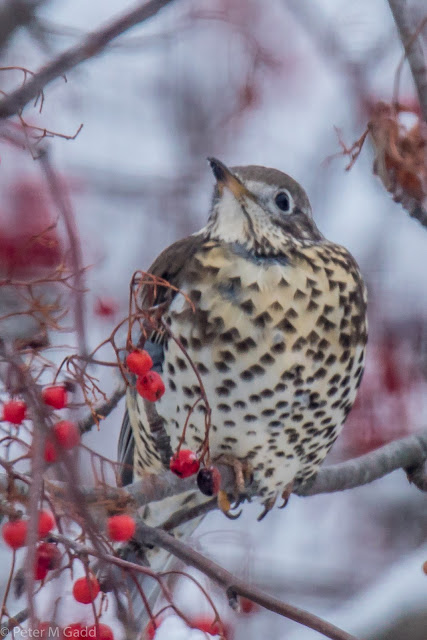
Saturday, December 9, 2017 was a watershed day for New Brunswick birders. On that day our rarest bird ever was found in the yard of Peter and Deana Gadd of Miramichi City. It was the confluence of several unusual factors that made this event possible. Peter Gadd is a naturalist/bird watcher and a photographer. The Gadd yard is large and filled with a huge, fruit-laden mountain ash which is a preferred winter food of thrushes. There is cover nearby in several large white pine trees. The province has an active naturalist network allowing fast, excellent communication among birders and experts. Peter and Deana are presently participating in a Feeder Watch Program so were watching their yard carefully that day to count the birds coming to their property for an online North American database. The weather had turned to winter conditions forcing birds to come to feeders and fruit trees. These factors precipitated the sighting of an unusual thrush which was recognized as unusual, photographed, and sent to local authorities who confirmed it as either a Song Thrush or a Mistle Thrush. Further emails and exchange of photos followed with further sightings, confirmed the visitor as a Mistle Thrush (Turdus viscivorus). A short time later the news became available to all New Brunswick birders. It quickly spread to Nova Scotia, Prince Edward Island, Quebec and Newfoundland. Within a short time the top birders all over Canada and the United States were informed of the presence of this special bird.
And special it is indeed! This is the first confirmed sighting of the Mistle Thrush in North America! Apparently the Song Thrush has been found once before in Quebec but the Mistle Thrush has not been documented every before in New Brunswick, in Canada or anywhere in North America! That makes it a mega-rarity.
| Mistle Thrush [Hank Scarth Photo] |
The Mistle Thrush is a bit bigger than our American Robin. It is shaped and acts like our robin but is bit more wary. It is 27 cm long (our robin is 25 cm). The most conspicuous marking is the heavily spotted breast and belly. The spots are dark brown or black, large, roundish and on a beige or white background. Some spots are arrowhead shaped. The back is a gray brown. The tail appears longish, is brownish gray with white fringes. The feet and legs are pinkish yellow. The throat is light in colour, has dark malar lines and the spots appear to coalesce around the edges of the throat. The bill is dark gray with yellow showing at the base. The lores are white and they extend to a narrow orbital ring. The wings have pale gray fringes. The wing linings are white or light gray, a field mark which distinguishes this species from the Song Thrush which has rusty-buff wing linings.
![]() |
| Mistle Thrush [Peter Gadd Photo] |
The Mistle Thrush flies in an undulating fashion and folds its wings during the gliding phase much like a pigeon. This undoubtedly gave it its Norwegian name, 'duetrost', which means pigeon thrush. The Mistle Thrush apparently sings when other thrushes are silent and often sings in bad weather. Unfortunately we did not hear this bird vocalize.
![]() |
| Mistle Thrush [Peter Gadd Photo] |
The Mistle Thrush breeds throughout Europe. It is a permanent resident of the United Kingdom, France, Germany, Belgium, northern Italy and northern Greece. It winters in southern Spain, southern Italy, the Middle East, and northern Africa. Its normal range does not include Iceland or Greenland.
![]() |
| Mistle Thrush [Peter Gadd Photo] |
So why or how did this bird come here? That is the big question. We have had a phenomenal fall for vagrants coming to New Brunswick. That is undoubtedly related to the severe wind storms and hurricanes that took place in the fall over North America and the Atlantic Ocean. Severe winds obviously blew this little bird well off course. The bird itself could also have its internal navigation system fouled up by disease, pollutants or other unknown factors.
Mega-rarities draw birders from afar. To date we have had birders from Maine, Quebec, and as far afield as Wisconsin. Many, many more will follow if the bird stays around. Good luck Mistle Thrush and to the birders who come to see it.
Addendum: The Mistle Thrush appears to have left as of April 8. The last confirmed sighting was on March 24 when it was seen by visitors from Maine and Arizona. In total 540 visitors were recorded by Peter and Deana Gadd who were the stewards of this rare visitor. There were certainly a few more who did not get recorded and many came repeatedly. Visitors came from 8 Canadian provinces and 28 US states including Texas, California, Oregon, Arizona and Florida. Canadians came from as far away as British Columbia and Alberta. Most people who came to see the bird were successful. The bird was coping well with our winter and did not seem to be affected by its many visitors.
Wednesday, December 13, 2017
A Weekend in Zermatt
The River Vispa runs through the village of Zermatt and the pointed summit of this mountain
can be seen just about everywhere you go in the village.
The Matterhorn is probably the most well-known and recognizable mountain in Switzerland.
I recently spent a long weekend in this mountain village
and this is the view we had from the hotel balcony.
The rising sun hits the side of the snow-powdered rocky surface.
Different times of the day create different moods and they were a constant source
of never-ending fascination.
There were other things to see of course,
like beautiful chalets and pretty red shutters and seasonal decorations.
Bars and cafés often have outside seating with sheepskin rugs
and thick warm blankets to keep warm in the crisp, cold air.
Many of the chalets are very old and have a great deal of charm.
The older the chalet, the darker the aged wood becomes, like this one above.
I have a special fondness for draped sheer curtains!
The hotel we stayed in is basically a big chalet with a modern wing which
is the reception, breakfast room and restaurant.
The hotel is very nicely placed just slightly out of the centre,
but with an easy ten-minute walk to the station.
Only electric vehicles are allowed here
and the air is beautifully pure.
This view just takes my breath away.
The Matterhorn is 4.478 metres high.
The German word 'Matte' means valley or meadow and 'Horn' means peak.
Here is the main church called St. Mauritius
This is the view you get as you come down the steps from the church
The front view from the steps on the old chalets and another mountain range.
One last shot of this iconic mountain at sunset when the sky was just turning
a shade of lavender.
We were so lucky with the weather which was sunny and quite cold.
On the last morning, it was -10 degrees Celsius,
but the average temperature during our stay was around -6C.
I really want to go back here again, but in the summer months so that we can do
more hiking and enjoy the alpine flowers.
Friday, December 8, 2017
Spread Holiday Cheer with Animal Friends
Exercise is extremely important for rabbits, especially young bunnies who are still growing, learning and developing important social skills. While adult rabbits require time every day for playing and exercising – at least 2 hours daily – it’s even more essential for babies, who should have at least 4 hours to sniff, play and explore each day.
And, the young kits at Animal Friends – like Parker and Porter – are no different. These 5-month-old brothers came to us from another shelter and we saw their playful and energetic personalities right away! Giving Parker and Porter plenty of opportunities to put their minds to work has helped them continue to learn and grow. With the help of enrichment toys like the Toss and Learn Carrot Game, they can even make the most of time spent in their kennels.
You can brighten the lives of our resident rabbits (and all of our animal friends) by sending them a little holiday cheer from our Amazon Wish List. For an added bonus, start your shopping at Smile.Amazon.com and designate Animal Friends as your charity and a portion of every purchase you make on Amazon will be donated to benefit our shelter residents. With the holiday season upon us and lots of online shopping to do, you can make a big difference in the lives of some very deserving animals.
Click here to see what our four-legged friends are wishing for this year!
Support Animal Friends By Doing (Almost) Nothing!
This holiday season, you may be looking for a special way to give back. But with no shortage of shopping, wrapping, traveling, cooking, cleaning and more, you may be short on time (and money!).
Thankfully, there is a way to make an impact in the lives of the homeless animals at Animal Friends with something you're probably already doing!
If you're shopping for gifts on Amazon, a portion of your purchase price can be donated to Animal Friends by using Amazon Smile! You'll receive the same items for the same prices, the only difference is how much brighter you'll be making the holiday season for the dogs, cats and rabbits at Animal Friends.
Just follow these quick and easy steps ...
- Go to Smile.Amazon.com and log in to your Amazon account.
- Search for "Animal Friends Pittsburgh" and select Animal Friends as your charity.
- Start shopping! Be sure to start at Smile.Amazon.com each time you shop to continue supporting Animal Friends all year long.
Barnacle Goose
Barnacle Geese Spotted near Florenceville
![]() |
| Barnacle Goose |
Three Barnacle Geese (Branta leucopsis) were spotted near Upper Kent, just north of Florenceville recently. Just above the Beechwood Dam there is a staging area and as many as 2000 geese have been seen there at once. Almost all of those geese are Canada Geese but occasionally there is a rare goose among them. About November 29 three Barnacle Geese were seen with the flock. They were photographed and verified by local birders. Unfortunately one was shot by a local hunter.
The photo above and subsequent photos in this post were taken by me of Barnacle Geese seen in New Brunswick at Miramichi City in 2011, but they will be used as illustrations for this post. I went to see the geese near Upper Kent but they were not there so hence no photos.
The Barnacle Goose is a smaller goose compared to the Canada Goose. It is 69 cm (27") long compared to 114 cm (45"). Even though it is marked differently from the Canada it can be difficult to spot in a large flock because of the similar colours and the way geese intermingle and sleep tucked in so well.
The Barnacle Goose is actually about the same size as the Cackling Goose (the smallest form of the Canada Goose which is now a separate species). Its shape and size is much like the Brant which passes by our shores in migration. It is gray and white overall with black on the neck, breast and as a hood. The face and underparts are white. The stubby bill and legs are black.
![]() |
| Barnacle Geese with Canada Geese |
The Barnacle Goose is very rare in New Brunswick. Its normal range is in Europe. Most birds breed in Svalbard and eastern Greenland. It builds its nest in dry Arctic tundra on cliffs and other rocky slopes and also on Arctic islands. They winter in the Netherlands, Denmark, Germany, Belgium, northern England and Scotland. They spend the winter on coastal pastures feeding on herbaceous plants and seeds. The birds that are seen here are probably from the eastern Greenland population.
This is the third report of Barnacle Geese to my knowledge in New Brunswick. I have seen one in 2001 in Salisbury, in 2011 in Miramichi City. The "Birds of New Brunswick: An Annotated List" does not even mention this species and it was published in 2004.
![]() |
| Barnacle Goose |
It is interesting how the Barnacle Goose got its name. It was an important part of medieval cuisine. It was believed that the Barnacle Goose came from actual barnacles. There is an actual Goose Barnacle and the confusion may have arisen from the similar colours of the barnacle and the goose and the fact that the goose appeared in different seasons. But, even more interesting, is the fact that Catholics believed they could eat the Barnacle Goose during Lent because of it perceived origin which meant it was classified as fish and could therefore be eaten during Lent.
![]() |
| Barnacle Goose |
This large flock of geese will probably stay around the St. John River as long as there is open water. It will gradually move southward and will eventually winter along the eastern seaboard. When I was there near Upper Kent on Tuesday, Dec. 5, the Barnacle Geese had been seen two days before but unfortunately I did not see them that day. It is possible they were still in the area. I saw about 800 geese that day, about 400 or more resting on the river and later a flock at least that big flying. I don't think it was the same flock because the big flock on the river left in much smaller flocks and at different times, presumably to go feed in nearby grain fields. Also seen were about 200 of each Black Ducks and Mallards. A wonderful spectacle indeed!
Subscribe to:
Posts (Atom)


